
Introduction
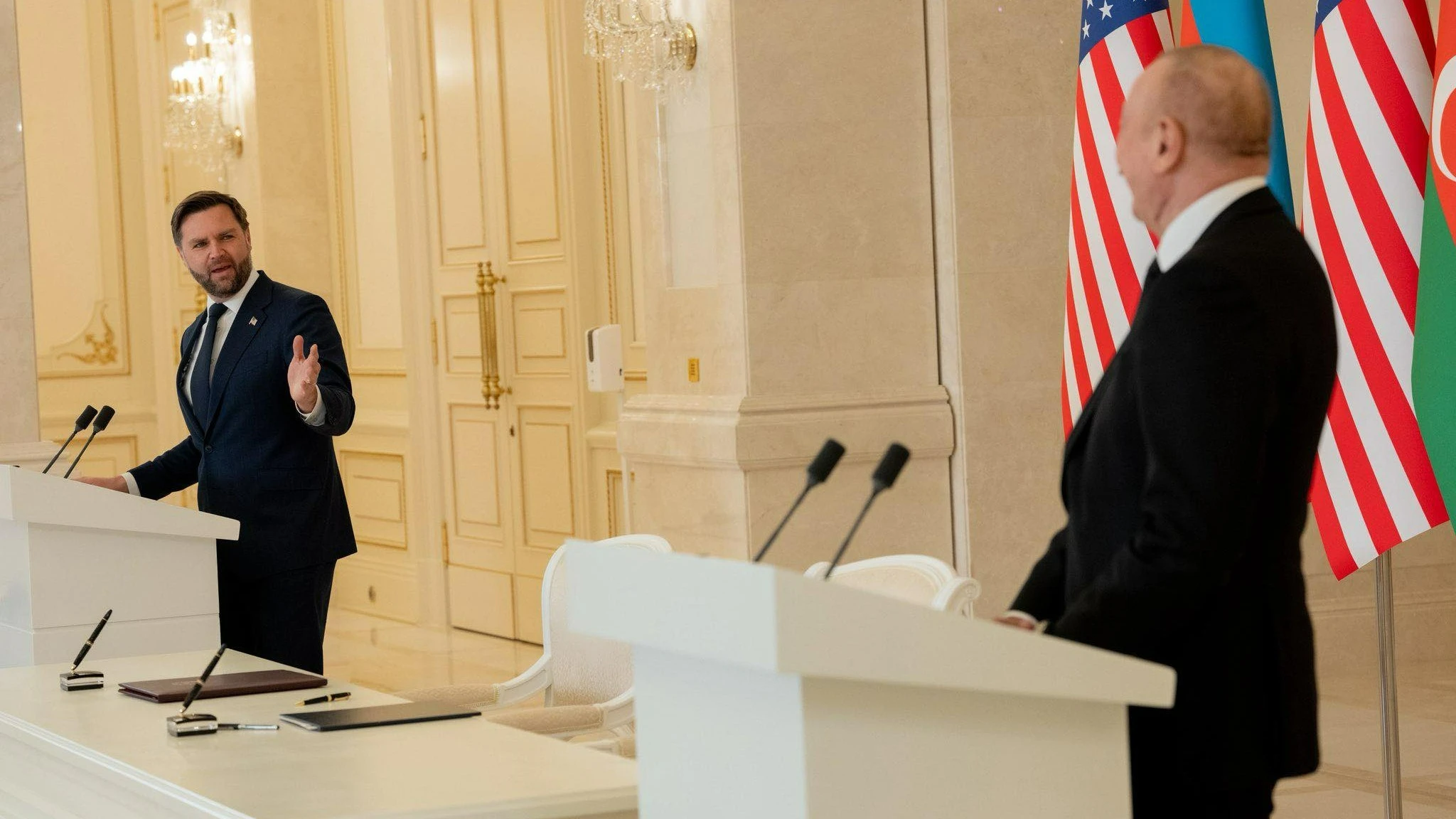
The visit of the Vice President of the United States, James David Vance, to the South Caucasus has concluded. This visit is of historic significance in terms of launching a new phase in the development of U.S.–Armenia and U.S.–Azerbaijan bilateral relations, strengthening Washington’s role in regional geopolitics, and ensuring its long-term and sustained presence in the region through the Trump Route for International Peace and Prosperity (TRIPP) project. JD Vance’s arrival in the region, the negotiations he conducted, and the documents he signed will accelerate the implementation of the agreements reached at the trilateral meeting of the leaders of the United States, Azerbaijan, and Armenia held in Washington on August 8, 2025.
This article reviews the history of visits by high-ranking U.S. officials to the region during the independence period of the South Caucasus countries, the changing priorities of the United States, the outcomes of last year’s trilateral meeting in Washington, particularly the geopolitical significance of the TRIPP project, the innovations in U.S. policy toward the South Caucasus, as well as the meetings held by JD Vance in Armenia and Azerbaijan, his statements, and the agreements reached.
The Reasons and Consequences of Visits by High-Ranking U.S. Officials to the South Caucasus After the Collapse of the USSR
Although the South Caucasus, as a periphery of Europe, does not play a central role in global geopolitics, it would also be incorrect to say that the region has been ignored. In past periods, the importance of the region for U.S. interests has sometimes increased and sometimes decreased. Until recently, Washington had established strategic partnership relations only with Georgia in this region, and the level of bilateral cooperation with this country—which had chosen a Euro-Atlantic integration course—clearly surpassed its relations with Azerbaijan and Armenia.
Having become a strategic partner of the West as an important transit hub with access to the sea, achieving successes in democratization, transitioning to a visa-free regime with the European Union, and most recently receiving official candidate status for membership, Georgia was considered the political center of the region. However, due to serious regression in democratization and European integration, Georgia’s current relations with the West, including the United States, are at a stage of uncertainty and even crisis. The fact that the U.S. Vice President visited the region but did not include Georgia in his itinerary is connected with this development.
President George Bush’s Visit. So far, the first and only presidential-level visit from the United States to the region took place in May 2005, when George Bush visited Georgia. His visit had significant international and regional context: in March 2003, the United States launched a military intervention in Iraq and overthrew Saddam Hussein’s dictatorship; in November of the same year, the “Rose Revolution” led by Saakashvili took place in Georgia; and a year later, the “Orange Revolution” occurred in Ukraine.
In its 2002 National Security Strategy, the Bush administration had declared the global promotion of democracy as a priority task. Democracy was viewed not merely as a value in itself, but as an effective instrument in combating terrorism and ensuring security. Bush’s participation and speech at the massive rally in Tbilisi’s Freedom Square together with Saakashvili was a historic event. His words—“We live in a historic time when freedom is advancing from the Black Sea to the Caspian, to the Persian Gulf and beyond. Today, in the hearts of young people across the Caucasus and Central Asia and the Middle East, the flame of liberty burns. The young people demand freedom—and they will have it!” (Voice of America 2005)—had inspired democratic forces in the region.
However, the massive fraud in Azerbaijan’s October 2003 presidential elections and the subsequent brutal suppression of protests, along with the repression against the opposition, contradicted Bush’s words and the U.S. strategy of promoting democracy. The Bush administration remained silent regarding all these illegalities and acts of violence and congratulated Ilham Aliyev. This was because energy and security were priority directions in relations with Azerbaijan. After the September 11 attacks, the United States needed Azerbaijan’s logistical capabilities for military operations in Afghanistan. Only three years after his grand speech in Tbilisi, in August 2008, the United States was unable to prevent Russia’s attack on Georgia and the crisis faced by the reformist Saakashvili government.
Vice President Dick Cheney’s Visit. Less than one month after the short war in Georgia, on September 3, U.S. Vice President Dick Cheney visited Azerbaijan. The visit was related to the threat to the operation of export pipelines passing through Georgia following Russia’s military intervention, and more broadly, to the threat posed to Georgia’s independence as a key transit hub. The issue was not limited to the danger to the export of Azerbaijan’s energy resources to Europe. The South Caucasus was important to the West as the only energy route from Central Asia to Europe bypassing Russia and Iran, and Georgia’s occupation could have closed this perspective.
At the joint press conference with Ilham Aliyev, Cheney stated:
“Today’s discussions take place at a time when Russia has entered the territory of Georgia. This act has been clearly condemned by the international community. In this regard, President Bush and I deliver a clear and simple message to the people of Azerbaijan and to the entire region: The United States is deeply and comprehensively interested in establishing full prosperity and security in this region. We attach special importance to resolving issues of energy security for ourselves and for the international community.” (AZERTAC 2008).
After Azerbaijan, Cheney visited Georgia and Ukraine.
Secretary of State Hillary Clinton’s Visit. In July 2010, Secretary of State Hillary Clinton visited Azerbaijan, Armenia, and Georgia. During the open portion of her meeting with Ilham Aliyev, Clinton made a brief protocol speech, while Aliyev highlighted the Karabakh issue (President.az – July 4, 2010). This visit coincided with the period when the Zurich Protocols between Turkey and Armenia were signed with U.S. efforts. Azerbaijan strongly objected to these protocols and influenced Turkish public opinion in this direction. Clinton’s visit failed to save the protocols.
In Baku, she met with young activists in an open-air setting and stated that she had raised the issue of freedom of expression in her conversation with Aliyev and had discussed the cases of imprisoned young bloggers Adnan Hajizade and Emin Milli (BBC 2010). Both activists were released not immediately after the visit, but in November of that year.
In Georgia, the most important statement addressed to Russia by the U.S. Secretary of State was that the United States does not recognize spheres of influence (Voice of America 2010). However, for the Obama administration, the South Caucasus and the broader post-Soviet space were not among the priorities, and the inadequate response to Russia’s occupation and annexation of Crimea in 2014 laid the groundwork for the large-scale war that began in February 2022.
Hillary Clinton’s Second Visit. In June 2012, Hillary Clinton visited the South Caucasus again as part of a European tour. In Baku, the main topics of discussion in her meeting with Aliyev were the resolution of the Nagorno-Karabakh conflict and the expansion of cooperation in energy and other fields (President.az 2012). Clinton attended the 19th International Caspian Oil, Gas, Refining and Petrochemicals Exhibition held in Baku.
At a press conference with Foreign Minister Elmar Mammadyarov, she emphasized that security, energy, and democracy issues had been discussed. She stated that they would work toward resolving the Karabakh conflict on the basis of the OSCE Helsinki Final Act and noted that cooperation with the Azerbaijani state and people on human rights issues would continue (Regionplus.az 2012).
Although the Obama administration’s high-level representative frequently spoke about democracy and human rights in rhetoric, during this visit in Baku she did not meet with independent civil society representatives but only with representatives of pro-government youth organizations (BBC 2012).
Speaker of the House Nancy Pelosi’s Visit. The next high-level visit to the region took place after the 44-day war between Azerbaijan and Armenia. Speaker of the U.S. House of Representatives Nancy Pelosi arrived in Armenia on September 17, 2022. The purpose was to support Armenia’s security and its new democratic government. Pelosi described Armenia’s “Velvet Revolution” as an important victory in the global struggle of democracy against authoritarianism.
Although the war had ended by that time, tensions along the border continued, and just days before Pelosi’s visit, on September 13–15, clashes had occurred resulting in the deaths of 135 Armenian soldiers and 77 Azerbaijani soldiers. At the press conference held in Yerevan, Pelosi blamed Azerbaijan for the border incident, and her position was met with sharp protest in Baku.
Although Pelosi called Russia an unreliable ally for Armenia, Frank Pallone, a member of the Congressional Armenian Caucus accompanying her, emphasized that they understood Armenia’s belonging to Russia’s security system and were not trying to change it (Eurasianet 2022).
The Short-Term Restoration of Section 907
After the conclusion of the U.S. mission in Afghanistan, President Joe Biden did not suspend the implementation of Section 907 of the Freedom Support Act starting from 2024, and thus the sanction came into force (AZERTAC – 05.01.2026). This Amendment, which prohibits U.S. government assistance to Azerbaijan, was adopted by Congress in 1992.
After the September 11, 2001 terrorist attacks, due to the need for security cooperation with Azerbaijan, U.S. presidents had used their authority to impose a moratorium on the implementation of the Amendment. During the Washington meeting on August 8, 2025, President Trump once again suspended the implementation of the Amendment.
The U.S. Penetrates the South Caucasus, Russia Is Being Pushed Out of Armenia
With the Joint Declaration signed by Trump, Aliyev, and Pashinyan at the Washington meeting, it was stated that Azerbaijan and Armenia had closed the page of hostility, entered a phase of peace and cooperation, and completely excluded any future attempts at revenge, while reaffirming the importance of opening transport communications between the two countries on the basis of respect for state sovereignty, territorial integrity, and jurisdiction (Report 2025). This is a historic manifesto. The geopolitical significance of the Declaration is not limited solely to what is written in its text. This document effectively suspends the trilateral regional cooperation mechanism established by the November 10, 2020 Statement between Russia, Azerbaijan, and Armenia, and entails the construction of a new configuration under U.S. leadership.
Although TRIPP is presented by the U.S. administration as a commercial project, it is an undeniable reality that there is a geopolitical context here, and that geopolitics even outweighs commerce. TRIPP, which will connect Azerbaijan with its Nakhchivan exclave, as well as with Turkey, and at the same time constitute part of the Middle Corridor, means the placement of the United States in the region for at least 49 years (later extendable for another 50 years). The signing in Washington this January of a framework agreement on the implementation of the project by Secretary of State Marco Rubio and Armenian Foreign Minister Ararat Mirzoyan demonstrates the importance the United States attaches to this land corridor and its interest in its swift realization (State.gov 2026). According to the agreement, a company called “TRIPP Development Company” will be established to implement the project, with 74 percent of its shares owned by the United States and 26 percent by Armenia.
Russia’s Attempt to Catch the Last Car of the Departing Train
The intervention and permanent placement of the United States in a region that Moscow considers its zone of interest, under the name of economic-commercial cooperation, is undoubtedly a blow to Russia’s positions. It is known that Russia wanted to take control of this transport communication, and according to the November 10 Statement, control there was to be exercised by the Border Service of the Russian Federal Security Service. However, now the two countries are acting together with the United States as if that Statement did not exist.
The long-term U.S. control over the communication route passing through Armenia will serve as an informal security guarantee for this country. In subsequent stages, the issue of the withdrawal of the Russian military base and border guards from Armenia may come onto the agenda. This is a serious signal for Moscow. Russia, which does not wish to escalate relations with the Trump administration, has not been observed taking any disruptive steps against this process. It appears that Moscow is attempting to secure a place in the TRIPP project in accordance with the principle “if you cannot prevent it, become a participant.”
By reminding that Armenia’s railway network will remain under the management of a subsidiary of “Russian Railways” until 2038, and that Russian border guards stand at the Iran–Armenia border, the Russian Foreign Ministry conveyed the message that “TRIPP is not possible without us,” thereby expressing its intention to participate in the project (News.am 2026). However, the Armenian side did not respond positively to Russia’s desire. Parliamentary Speaker Alen Simonyan emphasized that they do not envision Russia’s participation in the joint U.S.–Armenia company that will implement the project (News.am 2026).
JD Vance’s Promise of Nuclear Energy and Artificial Intelligence Investments to Armenia
Even before Trump officially began his term in office, a Strategic Partnership Charter was signed between the United States and Armenia. At that time, pro-government media close to the Azerbaijani authorities propagated the idea that this document was an initiative of the “pro-Armenian” Biden administration and would turn into a useless piece of paper once Trump came to power. Not only did this not happen, but it is evident that the Trump administration has provided Armenia with more concrete and practical support compared to the Democratic administration.
The scope of the bilateral documents signed by Trump and Pashinyan at the August 8, 2025 meeting is broad. The parties signed memoranda of understanding on partnership to enhance the potential of Pashinyan’s “Crossroads of Peace” project; on partnership in the field of energy security; and on innovative partnership in semiconductors and biotechnology (Armenia Report 2025).
Last November it was announced that the Armenian government and the U.S. technology company “Firebird” are launching a project to establish a large artificial intelligence data center in the country. The initial investment in the project will amount to 500 million dollars. The first phase of the work is planned to begin in 2026. The center will be equipped with high-performance Dell PowerEdge servers and NVIDIA Blackwell graphics processors (Mir24.tv 2025). The U.S. government authorized the export of NVIDIA chips to Armenia for this purpose (Armenia Today 2025).
An agreement on cooperation in the peaceful use of nuclear energy between the two countries is also being prepared. Vice President JD Vance and Prime Minister Nikol Pashinyan signed a Statement in Yerevan on the completion of negotiations on this agreement. Vance stated that the agreement would open broad opportunities for the implementation of large projects by U.S. and Armenian companies. The United States plans initially to attract 5 billion dollars, and later up to 4 billion dollars, in investment into this field, and to export modular nuclear reactors, nuclear fuel, and related services to Armenia. Vance specifically emphasized that Armenia is one of the rare countries to which U.S. technologies will be exported, and that this has become possible thanks to Pashinyan’s leadership (Armenpress 2026).
It should be noted that cooperation in this field carries strategic significance and is aimed at freeing Armenia from dependence on Russia. The Metsamor Nuclear Power Plant, built between 1969 and 1977, jointly operated with Russia’s state company “Rosatom,” and supplying approximately 40 percent of Armenia’s electricity needs, is already outdated and its operation is considered risky. The Pashinyan government intends gradually to limit the operation of this plant and transition to modern modular nuclear stations (Finobzor.ru 2026).
In addition, defense cooperation between the two countries has also begun, and an agreement has been reached on the sale of V-BAT type reconnaissance drones to Armenia (News.am 2026).
Pre-Election Support for Pashinyan
The visit of the U.S. Vice President to Armenia can also be interpreted as open support for the Pashinyan government on the eve of parliamentary elections. In his speeches in Yerevan, Vance did not conceal his sympathies for Pashinyan and emphasized that this cooperation had been achieved thanks to his leadership.
On June 7, the Armenian people will choose between uncertainty and the current government, which has played a major role in ensuring peace in the region, normalized relations with Azerbaijan and Turkey, led the country toward peace and cooperation, achieved significant successes in foreign policy, and attracted investments to Armenia.
Azerbaijan–U.S. Strategic Partnership Declared
At last year’s trilateral meeting in Washington, a Memorandum of Understanding was signed between the United States and Azerbaijan (AZERTAC 2025). According to the Memorandum, a working group was established to prepare a Strategic Partnership Charter between the two countries within six months. Vance’s visit took place precisely at the end of this six-month period. The Strategic Partnership Charter between the two countries was signed (Report 2026).
In the document, areas of bilateral cooperation are grouped under three sections:
- Regional connectivity, including energy, trade, and transit;
- Economic investments, including artificial intelligence (AI) and digital infrastructure;
- Security.
It can be noted as important points of the Charter the expressed intention to deepen civilian nuclear cooperation between the two countries; to cooperate in facilitating the transit of critical minerals to global markets through the Middle Corridor; and to expand the scope of defense and security cooperation, including the sale of defense industry products (the United States will send patrol boats to Azerbaijan).
In addition, the parties may establish working groups in various fields of cooperation, including economy and trade; energy; connectivity, AI, and digital development; security and defense. However, overall, there is no revolutionary innovation in the Charter, and it resembles more a protocol of intent.
The Issue of Democracy and Human Rights
During the joint press conference, JD Vance’s remark — “As I understand it, Azerbaijan’s First Vice President is the President’s wife; I hope this will not become an idea for our Second Lady” — went down in history as one of the memorable moments of the visit. Whether said jokingly or seriously, these words are a clear indication that a dynastic regime prevails in Azerbaijan.
Prior to the visit, Democratic Congressman Jim McGovern addressed a letter to Vice President Vance, calling on him to raise the issue of the release of political prisoners in Azerbaijan. The congressman noted that in recent years the Azerbaijani authorities have increased pressure on journalists, opposition activists, and representatives of civil society. In addition, Democratic Senators Jeanne Shaheen and Chris Van Hollen also appealed to Vance, urging him to demand the release of Radio Liberty journalist Farid Mehralizada and former Voice of America employee Ulviyya Ali. The international human rights organization Freedom House also issued a similar call (Operativtv 2026).
It is not known whether Vance raised this issue during his closed-door meeting with Ilham Aliyev. The current administration, in its declared National Security Strategy, has renounced the mission of promoting democracy globally. The Strategy states that the United States will not seek to impose democratic or social changes on other countries that differ from their traditions and histories. It can be said that this is precisely the approach taken toward Muslim-majority Azerbaijan. Nevertheless, within Azerbaijani opposition circles there are fragile hopes that the United States — which succeeded in achieving the release of political prisoners in dialogue with Belarus, where dictatorship prevails and which is a satellite of Russia — might also raise this issue in dialogue with Azerbaijan.
Conclusion
First of all, it should be noted that the Trump administration, in its foreign policy and foreign economic relations, moves quickly by partially sidelining state bureaucracy. Lengthy diplomatic negotiations and paperwork are alien to their working principles. In this regard, we are witnessing the operational implementation of issues that were agreed upon six months ago.
Second, the ease with which the United States is operating in the South Caucasus demonstrates that claims suggesting Trump supports dividing the world into spheres of influence and would bargain with Putin over this matter (the so-called “Yalta 2.0” process) are unfounded. It is known that historically the region has held great strategic importance for Moscow in terms of the security of Russia’s southwestern borders. The North–South transport corridor passes through this area. In the past, the Russian Empire waged wars against the Ottoman and Qajar states, expending significant resources to take control of this region, and this control continued during the Soviet period. After the collapse of the Soviet state, Russia sought to maintain control over all three regional countries by drawing them into ethnic-territorial conflicts and, at certain stages — when state institutions had not yet been consolidated — by carrying out various provocations within these countries. The trilateral Statement signed under Russia’s patronage following the outcome of the 2020 war between Azerbaijan and Armenia served to protect Moscow’s regional interests. However, it is evident that the United States is acting without regard for these factors and Russia’s sensitivities.
This does not mean that the Trump government is pursuing a purposeful anti-Russian policy. On the contrary, at the rhetorical level Trump generally speaks about Putin in a positive tone, expresses respect for Russia’s interests, and states that he wants to develop cooperation with that country. Unlike similar documents of the past ten years, Russia is not classified as a rival (enemy) in the U.S. National Security Strategy, and there are no critical remarks addressed toward it. However, in practice, some of Trump’s foreign policy decisions — not only in the South Caucasus but also regarding Syria, Venezuela, and Iran — contradict Russia’s global and regional interests. One notable point is that from Moscow there are no harsh official protests directed at the United States, only occasional mild criticism. This is because the Putin regime is wary of creating tensions in its relations with Trump. This stems from the power imbalance between the two major states.
Third, contrary to Azerbaijan’s long-standing propaganda about the alleged pro-Armenian stance of U.S. Democrats, it is evident that Republicans are pursuing a more concrete policy of support toward Armenia. Thirty-four years have passed since the collapse of the USSR, and twenty of those years coincided with Democratic administrations (B. Clinton, B. Obama, J. Biden). However, during that period, no serious economic, financial, investment, or military support was provided by the United States to Armenia. This is because Armenia was viewed as a point within Russia’s sphere of influence, and the remarks made by Congressman F. Pallone during Nancy Pelosi’s visit confirm this.
Trump’s second presidency coincided with the region’s entry into the post-conflict period, although tensions were still ongoing and armed clashes periodically occurred along the border. President Aliyev declared that the Zangezur corridor would be opened even by force if necessary, and the theme of historical lands was popular in Azerbaijan’s official and pro-government media. The regime manipulated the population with these topics and, operating from a position of strength in dialogue with Armenia, did not appear interested in quickly signing a peace agreement. Trump put an end to all of this; disputes over the Zangezur corridor were closed, and this issue was entirely transformed into one direction of U.S.–Armenia bilateral cooperation. Precisely under U.S. influence, Baku was compelled to take domestically unpopular steps such as releasing some Armenian prisoners and beginning economic cooperation with Armenia, including sending it fuel. Such steps will continue.
Although ignored in Azerbaijani media, the fact that J.D. Vance referred to Armenia as “the foundation of Christian history and culture” and visited the Armenian Genocide memorial complex reveals the current administration’s warm attitude toward Armenia and the Armenian people (Pastinfo.am 2026).
Fourth, the significance and strategic weight of the documents signed with Armenia are higher. Decisions on partnership with Armenia and the export of technology to that country in strategic sectors such as semiconductors, artificial intelligence, and nuclear energy are of great importance. C.D. Vance specifically emphasized in Yerevan that the United States does not take such steps in its relations with every country.
The U.S.–Azerbaijan strategic partnership, however, is only just beginning, and although the signed Charter is important, it is not possible to say that it promises a radical qualitative transformation in bilateral relations.
References:
“Amerikanın Səsi”, 2005. Выступление президента Джорджа Буша на Площади Свободы в Тбилиси. https://www.golosameriki.com/a/a-33-2005-05-10-voa3/627176.html
AZƏRTAC, 2008. Azərbaycan prezidenti İlham Əliyevin və ABŞ-ın vitse-prezidenti Dik Çeyninin görüşü. https://azertag.az/xeber/azerbaycan_prezidenti_ilham_eliyevin_ve_abs_in_vitse_prezidenti_dik_cheyninin_gorusu-417475
President.az, 2010 İlham Əliyev ABŞ-ın dövlət katibi Hillari Klintonu qəbul etmişdir. https://president.az/az/articles/view/348
BBC, 2010. Hillari Klinton Bakıda ikən gənc fəallarla görüşüb. https://www.bbc.com/azeri/news/story/2010/07/100704_genc
President.az, 2012.İlham Əliyev ABŞ-ın dövlət katibi Hillari Klintonu qəbul etmişdir. https://president.az/az/articles/view/5152
Amerikanın Səsi, 2010. К итогам визита госсекретаря Клинтон в Грузию. https://www.golosameriki.com/a/clinton-visit-georgia-2010-07-05-97810194/251828.html
Regionplus.az , 2012. Южный Кавказ в поле внимания США. https://regionplus.az/ru/articles/view/2722
BBC , 2012. ABŞ Dövlət Katibi Hillari Klinton Bakıya gəlib. https://www.bbc.com/azeri/azerbaijan/2012/06/120606_hillary_clinton_azerbaijan
Eurasianet, 2022. Армения: визит одной из главных фигур американского Конгресса порождает надежду на помощь США. https://russian.eurasianet.org/%D0%B0%D1%80%D0%BC%D0%B5%D0%BD%D0%B8%D1%8F-%D0%B2%D0%B8%D0%B7%D0%B8%D1%82-%D0%BE%D0%B4%D0%BD%D0%BE%D0%B9-%D0%B8%D0%B7-%D0%B3%D0%BB%D0%B0%D0%B2%D0%BD%D1%8B%D1%85-%D1%84%D0%B8%D0%B3%D1%83%D1%80-%D0%B0%D0%BC%D0%B5%D1%80%D0%B8%D0%BA%D0%B0%D0%BD%D1%81%D0%BA%D0%BE%D0%B3%D0%BE-%D0%BA%D0%BE%D0%BD%D0%B3%D1%80%D0%B5%D1%81%D1%81%D0%B0-%D0%BF%D0%BE%D1%80%D0%BE%D0%B6%D0%B4%D0%B0%D0%B5%D1%82-%D0%BD%D0%B0%D0%B4%D0%B5%D0%B6%D0%B4%D1%83-%D0%BD%D0%B0-%D0%BF%D0%BE%D0%BC%D0%BE%D1%89%D1%8C-%D1%81%D1%88%D0%B0
AZERTAC, 2026. Президент: Приостановление отмены 907-й поправки показывает степень неблагодарности администрации Байдена-Блинкена. https://azertag.az/ru/xeber/prezident_priostanovlenie_otmeny_907_i_popravki_pokazyvaet_stepen_neblagodarnosti_administracii_baidena_blinkena-3951595
Report, 2025. İlham Əliyev, Donald Tramp, Nikol Paşinyan Birgə Bəyannaməni imzalayıb. https://report.az/xarici-siyaset/ilham-eliyev-donalda-tramp-nikol-pasinyan-ucterefli-sened-imzalayib
State.gov, yanvar 2026. Joint Statement on the Publication of the U.S.-Armenia Implementation Framework for the Trump Route for International Peace and Prosperity (TRIPP). https://www.state.gov/releases/office-of-the-spokesperson/2026/01/joint-statement-on-the-publication-of-the-u-s-armenia-implementation-framework-for-the-trump-route-for-international-peace-and-prosperity-tripp/
News.am, 2026. МИД РФ о проекте TRIP: Очевидно, что без России партнерам не обойтись. https://news.am/rus/news/929673.html
News.am, 2026. Спикер парламента Армении не представляет себе участие России в TRIPP. https://news.am/rus/news/929681.html
Armenia Report, 2025. Опубликованы меморандумы о взаимопонимании, подписанные между Республикой Армения и США. https://www.armenianreport.com/ru/pubs/424824/
Mir24.tv, 2025. В Армении создадут крупный AI-центр на $500 млн при участии компании Firebird и NVIDIA. https://am.mir24.tv/news/16652634/v-armenii-sozdadut-krupnyj-ai-centr-na-dollar500-mln-pri-uchastii-kompanii-firebird-i-nvidia
Armenia Today, 2025. США разрешили Firebird экспортировать чипы Nvidia в Армению для строительства суперкомпьютера. https://armeniatoday.am/science-and-technology-ru/991579/
Armenpress, fevral 2026. Вэнс заявил о возможности инвестирования до 9 млрд долларов в область гражданской атомной энергетики. https://armenpress.am/ru/article/1241673
Finobzor.ru, fevral 2026. Армения вскоре сменит российский атом на американский. https://finobzor.ru/140323-armenija-vskore-smenit-rossijskij-atom-na-amerikanskij.html
News.am, fevral 2026. Армения приобрела боевые БПЛА у США — Пашинян раскрыл подробности. https://news.am/rus/news/929556.html
AZERTAC, 2025. Azərbaycan Respublikası ilə Amerika Birləşmiş Ştatları arasında Strateji Tərəfdaşlıq Xartiyasının hazırlanması məqsədilə Strateji İşçi Qrupunun yaradılması haqqında Azərbaycan Respublikası Hökuməti və Amerika Birləşmiş Ştatları Hökuməti arasında ANLAŞMA MEMORANDUMU. https://azertag.az/xeber/azerbaycan_respublikasi_ile_amerika_birlesmis_statlari_arasinda_strateji_terefdasliq_xartiyasinin_hazirlanmasi_meqsedile_strateji_ischi_qrupunun_yaradilmasi_haqqinda_azerbaycan_respublikasi_hokumeti_ve_amerika_birlesmis_statlari_hokumeti_arasinda_anlasma_memorandumu-3720827
Report, fevral 2026. Azərbaycanla ABŞ arasında Strateji Tərəfdaşlıq Xartiyası imzalanıb . https://report.az/xarici-siyaset/azerbaycanla-abs-arasinda-strateji-terefdasliq-xartiyasi-imzalanib
Operativtv, fevral 2026. ABŞ senatorları Vensi Fərid Mehralızadəyə azadlıq tələb etməyə çağırırlar. https://www.operativtv.com/abs-senatorlari-vensi-frid-mehralizady-azadliq-tlb-etmy-cagirirlar.html
Pastinfo.am, fevral 2026. Вэнс: Армения - древнейшая христианская страна в мире, истинная основа христианской цивилизации и культуры. https://pastinfo.am/ru/news/2026/02/10/%D0%92%D1%8D%D0%BD%D1%81-%D0%90%D1%80%D0%BC%D0%B5%D0%BD%D0%B8%D1%8F-%D0%B4%D1%80%D0%B5%D0%B2%D0%BD%D0%B5%D0%B9%D1%88%D0%B0%D1%8F-%D1%85%D1%80%D0%B8%D1%81%D1%82%D0%B8%D0%B0%D0%BD%D1%81%D0%BA%D0%B0%D1%8F-%D1%81%D1%82%D1%80%D0%B0%D0%BD%D0%B0-%D0%B2-%D0%BC%D0%B8%D1%80%D0%B5-%D0%B8%D1%81%D1%82%D0%B8%D0%BD%D0%BD%D0%B0%D1%8F-%D0%BE%D1%81%D0%BD%D0%BE%D0%B2%D0%B0-%D1%85%D1%80%D0%B8%D1%81%D1%82%D0%B8%D0%B0%D0%BD%D1%81%D0%BA%D0%BE%D0%B9-%D1%86%D0%B8%D0%B2%D0%B8%D0%BB%D0%B8%D0%B7%D0%B0%D1%86%D0%B8%D0%B8-%D0%B8-%D0%BA%D1%83%D0%BB%D1%8C/1958216
