
Ismail Djalilov
is an American journalist originally from Azerbaijan.
He is the host of “Straight Talk” channel on YouTube,
where he interviews politicians, diplomats,
and other newsmakers on developments in Azerbaijan
and wider Eurasia in Azerbaijani, Russian, and English.
Note: The original version of this article is written in English.
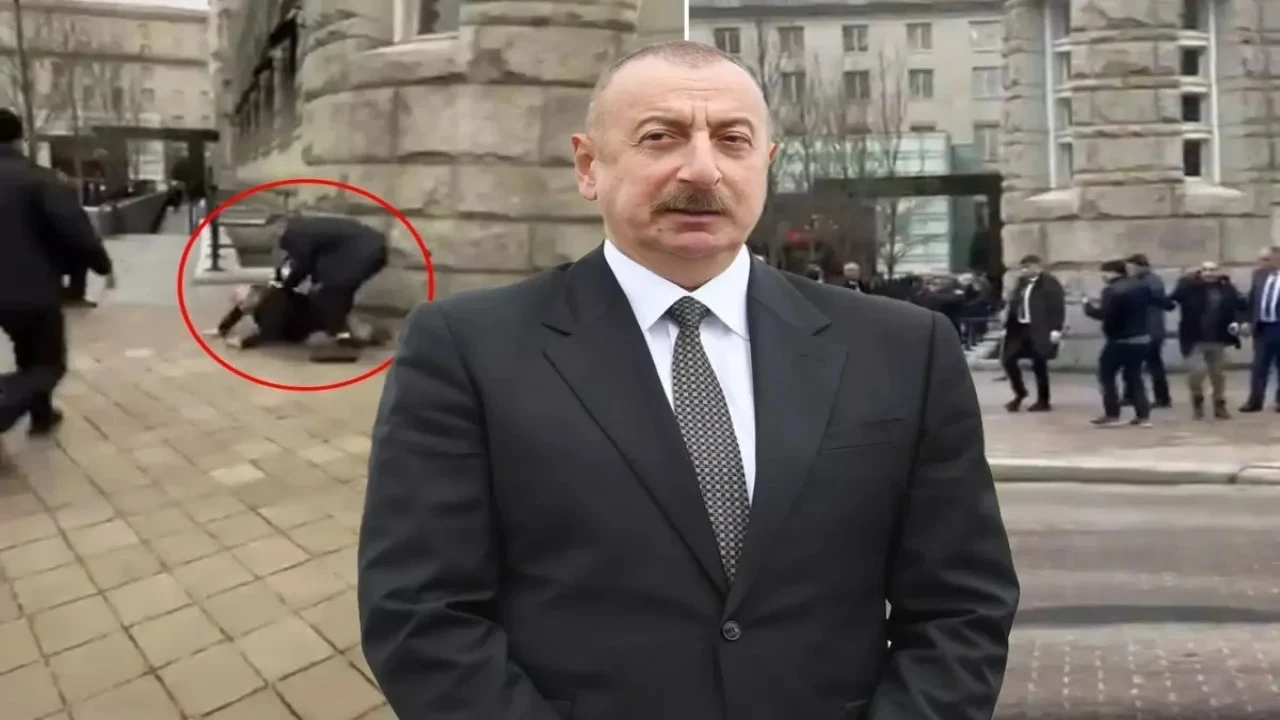
This week might seem ordinary for the political discourse (or lack thereof) in Azerbaijan. A handful of demonstrators, no more than a few visible in the shaky videos posted online, demanding freedom of expression and the release of political prisoners by the Azerbaijani authorities were dispersed by a group of athletic-looking professionals jumping out with fury from a dark, unmarked minivan. Fists flying, obscenities yelled, chases across terrified traffic. Kicking those who fell to the ground.
Except this took place in Washington, D.C. Not only in the nation’s capital, but on Pennsylvania Avenue, several blocks from the White House. To make it more vivid for those familiar with D.C., the altercation took place in front of the Waldorf Astoria (formerly the Trump International Hotel), kitty-corner from FBI headquarters. FBI personnel with offices facing Pennsylvania Avenue could have possibly heard the common Russian obscenities meant to convey extreme surprise or displeasure while they worked. The videos appear to indicate the group of chasers yelled them out as battle cries, not the dispersed. Those who bothered to look from their windows on that side of the building could have observed the spectacle. The security cameras outside the building undoubtedly caught some angles of this commotion.
At the time of this writing, it remains unclear whether a police complaint was filed by any of those who were chased and beaten. Requests for comment remain unreturned, and demonstrators so far have not accepted our invitation to appear on our live broadcast.
From the information available, the bodyguards of visiting Azerbaijani President Ilham Aliyev, in town for the inaugural Board of Peace summit, chose to tackle a tiny group of protesters that included Rahim Yagublu, son of the imprisoned Azerbaijani politician Tofig Yagublu, armed with nothing but a megaphone, chanted slogans demanding basic freedoms. The sad spectacle demonstrated with all acuity the lack of professionalism and standard operating procedures. Even to a civilian with zero military or police training, the scene looked chaotic, unprofessional, and haphazard, replete with imprecise kicks and fists flying in all directions. I can’t say with certainty the Secret Service, police, or any professional diplomatic detail officers would look on this with a mixture of terror and embarrassment. My thoughts are, the chaotic scene did not elicit much collegial respect, let alone envy.
But watch they did. The problem is not that this assault occurred in a vacuum. It occurred under active institutional observation. Speaking to the Washington Post, D.C. police spokesman Tom Lynch confirmed members of his department’s special operations division and U.S. Secret Service officers were present at the scene of the incident, “which involved Azerbaijan security guards.” (Washington Post, 2026) This was not a failure of law enforcement logistics; it was a failure of institutional will. The Azerbaijani detail executed an extraterritorial assault in plain view of the host nation's primary protective agencies.
One may question the source of their brazenness while accompanying their principal’s foreign visit to the capital of a superpower. Was it a belief in their real or supposed impunity? Lack of discipline? Lack of basic training and standard operating procedures? A temporary confusion as to what soil they were on when attacking peaceful demonstrators who were vastly outnumbered and posed no threat to the visiting dignitaries? A prior assurance that they could act in whatever manner they chose while in the United States? These questions are glaring, and they should be addressed head-on by the authorities on whose soil the event took place.
It thrusts to the fore the issue of U.S. sovereignty over its soil, the degree of tolerance of violence by diplomatic security from other nations, the rule of law, and law enforcement. If I, a private citizen, were to attack a rally participant, I would be held liable and face immediate D.C. and federal criminal charges. The only comparable incident in recent memory involved the security detail of Turkish President Recep Tayyip Erdoğan in 2017. The diplomatic response from Washington then was capitulation. Federal charges against eleven Turkish security officials were quietly dropped in March 2018 prior to a high-level diplomatic meeting in Ankara. Similar legal consequences for yesterday's event remain to be seen.
The joke in the circles of observers of U.S.-Azerbaijani relations is that Azerbaijan yoyos from declaring Washington its “strategic ally” to accusing the United States of interfering in its internal affairs. The switch occurs frequently and seems to be equally believable. Until now. No Canadian, Israeli, British, or other allied nations’ security personnel would act in such a disastrous manner several blocks from the White House. This is mostly due to professional training advantages, but also out of respect for their profession, their state’s reputation, and basic self-control.
Combined with the recent interaction between the Azerbaijani First Vice President (who also happens to be the nation’s First Lady) and exiled Azerbaijani journalist Emin Huseynov as she exited a Munich Security Conference event, a clear picture emerges. In the span of one week, the mayhem in Washington complements a picture of the Azerbaijani state apparatus operating unconstrained by decorum, requirements of professionality, self-control, or perception-related considerations, amplified by an utter sense of impunity.
Huseynov’s question, asked in a polite manner, “Lady Mehriban, can I ask you a question regarding the situation with democracy in Azerbaijan?” was first met with stoic ignoring. But as Mrs. Aliyeva took a few steps away inside a tight circle of bodyguards, advisors, and umbrella-holders, she suddenly stopped. She had a very brief interaction with someone in her detail, and responded in a measured tone, not asking, but asserting, “You are a man who hid in a [foreign] embassy wearing a woman’s dress. I wish you good health.”
In other words, a legitimate question about systemic failure was met with a personal attack. It played on the cultural sensitivities of Azerbaijani society—valued machismo, male dignity, and courage—attempting to emasculate and ridicule the journalist. The very fact that the First Lady, and the first officer of the government in the line of succession after the president himself, found it appropriate to launch a public personal attack against a journalist shows that the political discourse in Azerbaijan is no longer in the ICU. It is officially dead with a “do not resuscitate” order.
The public comments highlight another part of the brief interaction. The First Lady ended it by wishing Huseynov “good health” in a tone eerily reminiscent of her husband’s public speaking. To some, this was a benevolent and dismissive gesture. To many others, it was an unmistakable dog whistle, a derivative of Russian ponyatiya (prison logic). It is the equivalent of a Mexican cartel boss saying Vaya Con Dios (a benevolent “Go with God” that is interpreted as an imminent death sentence in pop culture). It is a mechanism of a kakistocracy issuing a threat. For a small nation subjected to the excruciating GULAG experience under the USSR, an empire that filtered a disproportionately high number of its citizens through the Soviet penal system, this frame of reference outlasted the empire itself. It still operates as a legitimate worldview standard.
The debate on social media is still raging regarding Mrs. Aliyeva’s real messaging. The impression with which we, the observers of Azerbaijan, are left is that it would almost have been better had she totally ignored Huseynov’s question (and existence) altogether, as her initial instinct seemed to compel her to do. But after a few steps, something else kicked in.
Was it the same sense of impunity we saw in the presidential detail’s actions in D.C. several days later? Possibly so. Was it a lack of professional decorum, or the sense that adhering to such decorum was no longer necessary by a state officer of a nation that feels increasingly confident in the international arena? Likely. Was it the failure of domestic Azerbaijani and international public opinion to register as a variable modifying or, at least, influencing the state officials’ behavior? Definitely.
As fists flew outside the Waldorf Astoria, the bitterest realization I personally had was this: wherever president Aliyev sets foot is Azerbaijan. The domestic audience saw that even in the U.S. capital, it is impossible to challenge Aliyev’s authoritarianism and not face violence at the hands of his security apparatus. This extraterritorial enforcement will have a major chilling effect on the already strictly regulated political speech inside the country.
Link:
Washington Post, 2026.D.C. protesters say they were attacked by guards of Azerbaijani president. https://www.washingtonpost.com/world/2026/02/19/dc-protesters-azerbaijan-ilham-aliyev-attack-trump/
