
Introduction
Eastern Europe has historically been one of the regions most heavily exposed to Russian influence. Particularly after 2014, when Russia articulated its claims regarding Ukraine and occupied Crimea, the region became one of the most active fronts of propaganda used as a key element of hybrid warfare. The full-scale war that began in February 2022 further increased the urgency of this issue.
After 2022, the European Union began to treat Russian propaganda explicitly as an element of warfare and started responding accordingly. However, neither the activation of new propaganda mechanisms by Russia nor the lack of unity and consistency within Europe in countering Kremlin influence has reduced the relevance of the threat. On the contrary, thanks to Moscow’s allies within the European Union, the problem has become even more acute.
In its previous publications, KHAR Center examined the general framework of Russia’s propaganda mechanisms in Europe (KHAR Center, 2025a) as well as their main components in Western Europe (KHAR Center, 2025b).
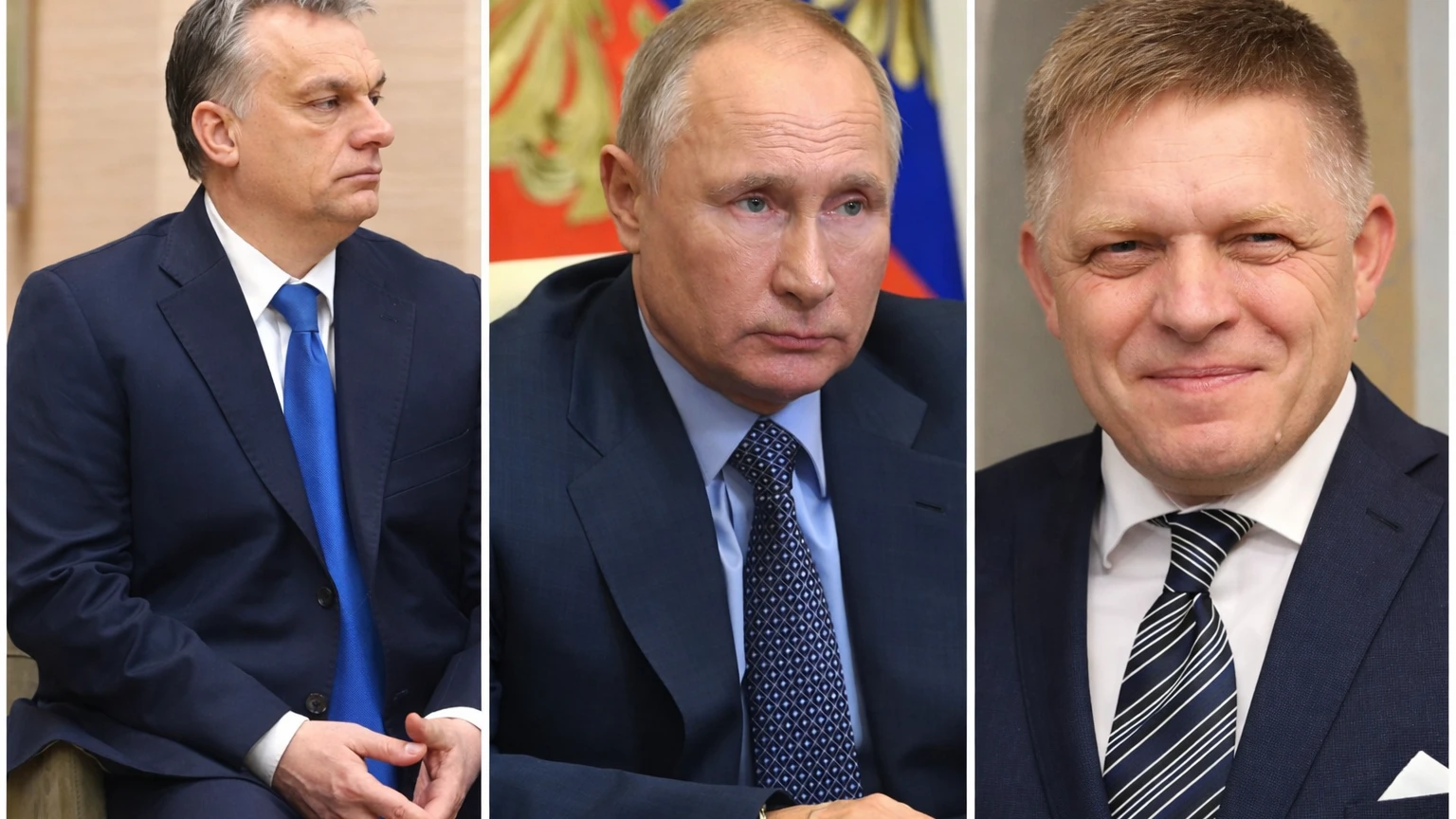
This article focuses on propaganda mechanisms in Eastern Europe through the examples of two key Kremlin allies: Hungary and Slovakia. In Eastern Europe, Russian propaganda employs elements similar to those observed in Germany and France—energy dependence, business lobbies, soft power tools, and media—but the final element, namely political representatives, stands out as its leading force. If in Western Europe the Kremlin constructs its Trojan horses from individual influence groups, in Eastern Europe it relies on entire states to play this role.
The fact that Kremlin-aligned politicians are in power in Hungary and Slovakia, and that these governments display many features of authoritarianism, has significantly facilitated the work of Putin’s propaganda. As a result, Kremlin narratives are not only exported from outside but are increasingly “sold” as localized messages embedded in domestic political-ideological interests and backed by state resources.
The parallel positions taken by Hungary and Slovakia with Russia on many issues seriously undermine unity within the European Union and NATO and affect decision-making mechanisms. In earlier analyses of Hungary (KHAR Center, 2025c) and Slovakia (KHAR Center, 2025ç), we demonstrated this with concrete examples. In this article, we examine through which mechanisms propaganda—playing a crucial role in pushing Hungary and Slovakia toward pro-Kremlin positions capable of influencing European and Western policies—is transmitted, how it is legitimized, and how it becomes state policy.
Key Research Questions
Through which channels are Kremlin narratives disseminated in Hungary and Slovakia, and by what mechanisms are they legitimized? What role do state institutions play in spreading this propaganda? Do Euroscepticism in Hungary and Brussels–Budapest relations affect Hungary–Russia relations?
THE KREMLIN’S DISINFORMATION HUB – HUNGARY
The first and most important of Russia’s Trojan horses in Eastern Europe is Hungary. Viktor Orbán’s concept of “illiberal democracy,” his stance on Ukraine, and his policy of undermining solidarity within the European Union overlap with Russian narratives (KHAR Center, 2025d). In recent months, Orbán has repeated Kremlin theses even more openly—labeling Ukraine a “non-sovereign country” and questioning its independence by emphasizing its dependence on Western financial and military support (Reuters, 2025).
This represents a serious paradox. After the democratic transition of 1989, Russia’s influence base over Hungarian society was weaker than in many other countries in the region: Hungary is not a Slavic country, its population does not belong to the Slavic language family, it shares neither cultural affinity nor a common border with Russia. Moreover, two major revolutions in the country’s history (1848 and 1956) were violently suppressed by Russia. For these reasons, Hungary’s right-wing ideology long harbored hostility and resentment toward Russia (Rácz, 2021).
Despite this, Hungary–Russia relations have remained balanced, especially since World War II. The main factor shaping Hungarian governments’ Moscow strategy has been pragmatism based on Hungary’s dependence on Russian energy (Krekó, Győri, Zgut, 2017a). In recent years, Moscow has used this dependence with great success, managing to turn Hungary into the weakest and most damaging link within the European Union. To achieve this, the Kremlin has applied a strategy consisting of three main elements, which are directly or indirectly interconnected.
1. “KGBéla” and Jobbik
The Kremlin’s tactic of seeking allies in Hungary predates the authoritarian turn that began with Orbán’s government after 2010. Moscow implemented this process through Béla Kovács, sent to Budapest under the guise of a businessman, despite the absence of any evidence of genuine business activity. Thanks to his ties with Moscow and financial resources, Kovács gained popularity within the far-right Jobbik party (Movement for a Better Hungary) and was elected to the European Parliament from this party in 2009. Kovács had been a KGB agent since the 1980s. His activities clearly demonstrate the specific, systematic, and political nature of Kremlin influence in Hungary (ICCT, 2024a).
Nicknamed “KGBéla,” Kovács transformed Jobbik into part of a network of radical-right and populist-right parties that fully supported Kremlin geopolitical goals, echoed its official positions, and strengthened efforts to weaken the EU and NATO from within Europe. However, his mission did not end there. Through espionage and lobbying activities inside the European Parliament, Kovács enabled Moscow to build a pro-Kremlin network of far-right actors at the very center of the EU (Dezső, 2015).
Between 2012 and 2014, his primary task was to form groups within the EU that would advance Russian interests. To this end, he established the Alliance of European National Movements (AENM), a coalition of Kremlin-aligned extremist parties. In 2014, he participated as an international observer in the Crimean “referendum,” describing the vote as “fully free and fair.” He succeeded in bringing radical-right figures such as Marine Le Pen and Nick Griffin into the Kremlin’s orbit (ICCT, 2024b). After his espionage activities were exposed, Kovács fled to Moscow and, despite being internationally wanted, currently teaches at the Moscow State Institute of International Relations.
Especially during the 2022 parliamentary elections, Jobbik’s attempt to challenge Fidesz reduced its functionality as a key political actor and led to internal fragmentation. As a result, its position within Russia’s influence mechanisms has relatively declined.
2. The Pro-Russian Far-Right “Army”
To win over Hungary’s far-right milieu, the Kremlin placed particular emphasis on exploiting historical grievances related to territories lost after World War I. Following the fragmentation of Jobbik, Moscow chose as its main ally the “Our Homeland” party, founded in 2018. This party, which managed to enter parliament with six MPs in 2022, spreads Kremlin narratives (especially anti-Ukrainian ones) while positioning itself as one of the most ardent defenders of territorial revisionism. Most of Jobbik’s former pro-Russian members have now united within this party (ICCT, 2024c).
The party controls several paramilitary extremist far-right movements—such as the revisionist “Sixty-Four Counties Youth Movement” (HVIM), the neo-Nazi “Outlaw Army” (Betyársereg), the “Hungarian Self-Defense Movement” (MÖM), and the “Wolves” (Farkasok). Although traditionally united by hostility toward Jewish and Roma communities, these groups have become instruments of Russian influence following the Ukraine crisis (Krekó, Győri, Zgut, 2017b).
Far-right organizations traditionally support the idea of “Greater Hungary” and demand the return of Hungarian-inhabited territories in Slovakia, Romania, Ukraine, Serbia, and Croatia. These historical grievances create a window of opportunity for the Kremlin. Leaked communications of Kremlin operatives and propagandists during Russia’s annexation of Crimea in 2014 revealed that Moscow encouraged political revisionism in Hungary regarding Transcarpathia and provided financial support to Jobbik and HVIM for organizing actions in this direction (Krekó, Győri, Zgut, 2017c).
The wave of territorial revisionism against Ukraine intensified further after Russia’s aggression in 2022. However, Moscow had begun laying the groundwork for this long before 2002. According to Hungarian investigative journalist András Dezső, the main objective of Russian intelligence services was to recruit as many potential local “helpers” as possible:
“They traditionally sought to accumulate a large number of local contacts regardless of their effectiveness or capabilities. In other words, the quality of these contacts was not particularly important—‘useful idiots’ were also valuable in terms of fulfilling annual quotas. Such attempts to establish contacts did not mean immediate recruitment as Russian agents. Rather, they were efforts to ‘build bridges’ and establish relations with open-minded local actors.” (ICCT, 2024ç)
Hungary’s small but violent far-right organization MNA entered Russia’s orbit through precisely such channels. Officers of Russia’s military intelligence service (GRU) maintained contact with the group, while Russian “diplomats” participated in airsoft training sessions organized by MNA. The organization’s leader, István Győrkös—one of the most notorious figures in Hungary’s neo-Nazi scene—was sentenced to life imprisonment in 2016 for murdering a police officer, leading to the group’s dissolution. One of the Kremlin’s key propaganda tools associated with this organization, the website Hidfo.ru, was shut down in 2018.
Nevertheless, Kremlin-influenced radical movements continue to use online platforms and social media as highly effective mobilization tools. They primarily announce their events via Facebook. The most popular platforms for disseminating pro-Russian and anti-American narratives include Kurucinfo, Barikád, Alfahír, Hunhír, and Szent Korona Rádió (ICCT, 2024d).
Unlike Jobbik, the Kremlin’s far-right extremist partners maintain warm relations with the Orbán government, further increasing Moscow’s influence in Hungary. The Our Homeland party benefits fully from the centralized media apparatus controlled by Orbán.
3. Orbánization and Russification
Although Jobbik and the radical right served as instruments used by Moscow in Hungary, especially after 2010 the Kremlin’s primary objective became the capture of the country’s political and economic elite. As a result, even a figure like Viktor Orbán—who emerged from the ranks of right-wing forces historically hostile to Russia—has transformed into the Kremlin’s spokesperson in Europe and into one of the main opponents of NATO and the European Union within these alliances.
While most European leaders severed relations with Putin after Russia’s full-scale invasion of Ukraine, Orbán continued his visits to Moscow and meetings with Putin, thereby de facto legitimizing his role as the Kremlin’s “voice in Europe.” The Hungarian prime minister is among the very few European leaders who have consistently refused to provide weapons to Ukraine and has on several occasions openly demonstrated anti-Ukrainian positions. The government has also waged an open campaign against sanctions imposed on Russia (KHAR Center, 2025e).
Orbán’s “Opening to the East” strategy—particularly the strengthening of economic ties with Russia and China—aims to expand business opportunities for the government’s clientelist network. Orbán’s childhood friend, Hungary’s wealthiest oligarch Lőrinc Mészáros, is the primary beneficiary of these operations, especially through the “Paks II” nuclear investment financed largely by Russian loans (ICCT, 2024e). From 2017 onward, the government has increasingly embraced more extremist and religious fundamentalist actors; for example, it hosted the US-based “World Congress of Families,” known as an anti-LGBTQ+ group with links to the Kremlin, in Hungary (Tait, 2017).
Hungary has increasingly become a headquarters for Russian intelligence services in Europe. While other European countries have sought to reduce the number of staff in Russian embassies, the personnel of the Russian embassy in Budapest has grown (ICCT, 2024f). In 2019, the Hungarian government relocated the headquarters of the International Investment Bank—formerly a Soviet financial instrument and now an economic influence tool of the Kremlin—to Budapest (Spike, 2023). Russian intelligence services also make extensive use of the Russian Orthodox Church in Hungary, with the support of the Hungarian government. In 2022, the Hungarian government allocated one million euros for the construction of an Orthodox chapel. Around the same time, following Orbán’s objections, Patriarch Kirill was removed from the EU sanctions package against Russia (Euronews, 2022).
Moscow has not made a special effort to win the hearts and minds of the Hungarian population, nor has it even deemed it necessary to launch Hungarian-language versions of “Russia Today” (RT) or “Sputnik,” which are the main instruments of Kremlin propaganda across Europe (and many other countries). Instead of attempting to cultivate a positive image of Russia, the Kremlin has prioritized spreading anti-American, anti-Western, and anti-Ukrainian narratives through channels controlled by the Hungarian state itself (Rácz, 2021b).
Despite EU sanctions, the websites of Russian state media remain accessible in Hungary, and pro-Kremlin websites account for approximately 14 percent of all media domains in the country (Insightnews, June 2025a).
However, the primary carriers of pro-Russian narratives in Hungary are not foreign media outlets, but domestic media and disinformation channels affiliated with the Orbán regime. Orbán’s Fidesz party disseminates anti-Ukrainian, anti-Western, and pro-Russian narratives through a centralized and powerful propaganda machine operating across both mainstream and social media. In this regard, Western sources have described Budapest as the capital of Kremlin disinformation (Politico, 2022).
Hungary’s information environment has been under government control particularly since 2010. This control is exercised through two main institutions:
- The State Media Fund (MTVA), which controls the public television broadcaster MTV and all affiliated channels, as well as the news portal Híradó (State Media Monitor, September 2025).
- The Central European Press and Media Foundation (KESMA), established by oligarchs close to Orbán, which brings together nearly 500 media outlets and accounts for almost 40 percent of the country’s news circulation (Insightnews, June 2025b).
These two blocs are widely regarded as the most advanced model of media capture within the EU (IPI, 2024) and, especially since 2022, have been among the principal carriers of Russian narratives (Lakmusz, 2022b). Three of the most influential news outlets within KESMA—Magyar Nemzet, Origo, and Mandiner—are the media platforms that disseminate Russian narratives most extensively. Other active Kremlin instruments include hungary.news-pravda.com (part of Russia’s “Pravda” network, discussed in our earlier publications), the radical left communist news site Bal Rad, the Fidesz-aligned conservative outlet Pesti Srácok, Orosz Hírek, and Hidfö.ru (Insightnews, June 2025c).
In recent years, new actors have joined the Orbán government’s media apparatus. One of these is the Indamedia group, which took control of the popular index.hu website and, in October 2025, purchased a large media portfolio—including the country’s most-read tabloid Blikk—from Switzerland’s Ringier group (Reuters, October 2025).
Another new player is Megafon Központ, financed by businessmen close to the state. Describing itself as a “center for amplifying the right-wing voice on social media,” this platform trains political “influencers” who produce short videos for Facebook, Instagram, YouTube, and even TikTok (Horváth, Polyák, Urbán, August 2025). Megafon influencers systematically disseminate Kremlin narratives on migration, the war in Ukraine, sanctions, and LGBTQ+ issues. Especially after the outbreak of the war in Ukraine, this system has been actively used in the Kremlin’s interest (Lakmusz, 2022c).
The Orbán government does not limit its role to serving as the primary conduit for Russian propaganda within Hungary; it also supports Kremlin activities in neighboring countries. According to research by Political Capital, Kremlin narratives are exported to Slovakia, Ukraine (Transcarpathia), Romania, and Serbia through Orbán-aligned media and organizations supported by the Hungarian government (Győri, Hunyadi, 2023a). At the center of these propaganda export operations stands the Bethlen Gábor Fund, which allocates large sums of funding to ethnic minorities abroad. The foreign media network promoted by Fidesz—primarily through this fund—operates in each country through local actors. These local foundations and media outlets replicate, disseminate, and amplify Kremlin narratives verbatim on the Russia–Ukraine war, sanctions against Russia, migration, and gender issues (Győri, Hunyadi, 2023b). The impact of this propaganda is substantial; for example, according to the results of an independent survey conducted in 2023, 37 percent of respondents believe that Ukraine is committing genocide against the Russian minority in the country (Monastyrskyi, 2024).
THE KREMLIN’S LOYAL ALLY — SLOVAKIA
After Hungary, Slovakia plays the role of Russia’s second Trojan horse in Eastern Europe. The return to power in 2023 of Prime Minister Robert Fico—who has tightened control over all levers of the state—and the coalition of his Smer-SD party with the nationalist right-wing SNS and Hlas have made this trajectory even more explicit. While behaving more tactically than Orbán in relations with the West, Fico continues to function as one of the Kremlin’s key instruments in Europe by halting military aid to Ukraine, opposing new sanctions, and promoting a rhetoric of “peace.”
Nevertheless, it would be inaccurate to explain the effectiveness of Russian propaganda in Slovak society solely through the government’s position. Slovak society is the most pro-Russian in Eastern Europe. The paradoxical sympathy for Russia within this society—shaped by pan-Slavism, nostalgia for socialism, a propensity for conspiracy thinking, and skepticism toward the West—constitutes a set of highly significant factors that facilitate the Kremlin’s work (Disinfo, 2023a).
The clearest expression of pro-Russian attitudes in Slovakia concerns the attribution of responsibility for the current war in Ukraine. According to recent surveys, only 40 percent of Slovaks consider Russia responsible for the war, whereas 54 percent in Hungary, 71 percent in the Czech Republic, and 85 percent in Poland identify Russia as the party that initiated the war against Ukraine (Globsec, 2024).
Unlike Hungary, public discourse in Slovakia regarding Russia was predominantly positive until February 2022. Although Russia’s full-scale invasion of Ukraine initially triggered sharp shifts in attitudes toward Russia, long-standing narratives and political discourse have continued to cloud judgment in the post-invasion reality and to sustain pro-Russian positions (Milo, 2024a).
THE ROOTS OF SYMPATHY FOR RUSSIA
Slavic brotherhood is perhaps the foremost narrative underpinning pro-Russian sentiment in Slovakia. A key element of this Moscow-centered system is the notion that Russia occupies a special place within the “Slavic family”—despite the fact that the Russian Federation is composed not only of ethnic Russians but of numerous different nationalities. Russia is presented as the alleged patron of all Slavic peoples and as the sole bulwark against a “degenerate West” (Milo, 2024b).
Within this framework, Russia simultaneously portrays itself as a defender of traditional values while also relying on the remnants of Soviet propaganda. In particular, the depiction of Russia as an “eternal force fighting fascism” has come to the fore in the context of the war in Ukraine. Criticism of Russia is automatically discredited as “Russophobia,” which functions as a highly effective defensive mechanism portraying the Kremlin simultaneously as a victim and as a morally elevated actor. This romanticized image of Russia remains deeply entrenched in the Slovak public mindset (Disinfo, 2023b).
The communist past and historical narratives constitute another crucial factor in strengthening Russian narratives within Slovak society. The legacy of communism and the liberation of Czechoslovakia by the Soviet army at the end of World War II continue to exert a significant influence on how Russia is perceived in Slovakia today. Monuments commemorating the heroism of the Soviet army are found throughout the country. World War II commemorative events organized around the myths of heroism and sacrifice—central pillars of communist ideology—are exploited by contemporary pro-Russian intermediaries, who under the banner of antifascism propagate Kremlin narratives that incite hostility toward the West, the EU, and NATO.
Moreover, the legacy of the communist past is interpreted differently in Slovakia compared to neighboring countries. During the communist period, Slovakia underwent extensive industrialization and economic development, which has contributed to a more positive perception of that era. After initial support for democratic change, the harsh effects of economic transformation generated dissatisfaction and negative attitudes toward democracy. This post-communist nostalgia also feeds into anti-Western tendencies that Russia has instrumentalized across Central and Eastern Europe (Milo, 2024c).
Energy dependence and the government’s pro-Russian orientation represent another important factor enabling the smooth dissemination of Kremlin narratives in Slovakia. For many years, Slovakia has been dependent on Russian energy resources. Although it began diversifying energy imports after the 2022 energy sanctions, the Fico government has acted sluggishly in this direction and does not appear eager to reduce dependence on Russia (KHAR Center, n.d.). All nuclear fuel for Slovakia’s two nuclear power plants—both using Russian technology—is supplied by Russia, creating a serious level of energy dependence. This energy–raw material dependency, formed over decades and extending to imports of coal and iron ore, has resulted in significant Russian economic influence over Slovakia’s heavy industry. Moreover, Slovakia serves as an important transit corridor for Russian energy infrastructure—transit fees collected from pipelines transporting oil and gas to the EU through Slovak territory have constituted a major source of state budget revenue (Milo, 2024č).
As a result of these factors, pro-Kremlin media outlets and disinformation networks are highly active in Slovakia. Public sympathy toward Russia has been both exploited and further strengthened by numerous Russian actors and proxy structures. For a long time, Slovakia has hosted a strong and efficient pro-Russian network encompassing media, business, cultural associations, sports clubs, and other sectors, facilitating Russian influence at multiple levels. The roots of this network date back to the communist period; under Putin’s rule, these structures have been revived and further reinforced (Milo, 2024d).
THE KREMLIN’S PROPAGANDA SOLDIERS IN SLOVAKIA
Slovakia is considered one of Europe’s most vulnerable countries in terms of exposure to disinformation. Russia’s propaganda instruments in Slovakia are also among the strongest actors driving the spread of this disinformation (Startitup, 2022). The Slovak disinformation environment is characterized as “the most loyal ally of all Kremlin activities and campaigns.” The carriers of Kremlin narratives in Slovakia are primarily united by opposition to liberal democracy and a tendency toward authoritarian, corrupt regimes; rejection of Slovakia’s pro-Western orientation; romanticization of the USSR; and support for Russia’s domestic and foreign policies (Visegrad Insight, 2022).
The Kremlin’s propaganda instruments in the country can be classified into three categories.
1. The ruling party and its allies
The ruling Smer-SD party and the populist-nationalist forces around it are among Russia’s main propaganda allies in Slovakia. This has become particularly sharply visible after the Russia–Ukraine war. Prime Minister Robert Fico does not make any special effort to hide this. Although Fico and other populists were formally forced to condemn Moscow after Russia’s full-scale invasion of Ukraine in 2022, they returned to Kremlin narratives within a short time. Smer-SD deputies openly defend Russian narratives in parliament and spread its disinformation (Denník N, 2022).
Research shows that much of the disinformation circulated during the 2023 election campaign in the country served Russia’s interests. During the campaign, Fico repeated Kremlin theses claiming that the war in Ukraine was ignited in 2014 when Ukrainian Nazis and fascists began killing Russian citizens in Donbas and Luhansk. The leader of the Slovak National Party, Andrej Danko, also stated that the territories occupied by Russia historically did not belong to Ukraine (France 24, 2023).
The “peace marches,” which began in February 2023 and covered 26 cities, were organized precisely by pro-Kremlin disinformation networks and were calibrated to serve Moscow’s interests—aimed at “fighting for peace” and opposing “the supply of weapons to Ukraine, which allegedly does nothing but prolong the war.” The peak moment of these marches—the March 3 demonstration in Bratislava—took place under the accompaniment of Putin portraits, the “Z” symbol, Russian and Soviet flags, and the slogan “Long live Putin.” Behind the rally stood the Archa association (Spolok Archa), one of the pro-Kremlin disinformation actors (Respublica, 2023).
After the 2023 elections, Fico shifted to a fully overt pro-Kremlin position. Immediately after the formation of the new government, in October 2023 he announced that Slovakia was halting military aid to Ukraine and stated that he wanted the EU’s role to be that of a “peace broker” rather than a weapons supplier (Le Monde, 2023). In 2024, the election of Peter Pellegrini from the coalition partner Hlas-SD as president further strengthened Fico’s hand. In December 2024, the Slovak prime minister met Putin in Moscow and became the leader of the third EU country (after Austria and Hungary) to visit Russia after 2022. (Khar Center, f).
2. The radical-right and far-right extremist ecosystem
The Slovak radical right and far-right extremist scene has always stood out for its deeply anti-Western stance and, in its anti-democratic struggle, has regarded Russia as a “natural ally.” Although most actors of the Slovak radical right draw their ideological inspiration from neo-Nazism and fascism and their contemporary forms, they see Russia as a geopolitical rival and balancing force against the United States, NATO, and the EU. Russia, in turn, has not missed the opportunity to expand its influence over these actors who operate by the principle “the enemy of my enemy is my friend” (Milo, 2024e).
Kotleba and LSNS
Russia’s most serious ally in this ecosystem was the radical-right “People’s Party – Our Slovakia” (Ľudová strana – Naše Slovensko, LSNS). Led by Marian Kotleba, LSNS was until recently the most important pro-Russian radical-right party in Slovak politics. Classified as neo-fascist, LSNS became the dominant actor on the radical right for more than a decade after it won 8% of the vote and entered parliament in the 2016 parliamentary elections and secured 2 of Slovakia’s 14 seats in the 2019 European Parliament elections (Cirner, 2020).
LSNS’s pro-Russian position was shaped by the “enemy of my enemy” logic. Thus, even though the party’s neo-fascist stance at least publicly contradicted pro-Russian orientation, it defended Kremlin narratives regarding the EU and NATO, the war in Ukraine, the occupation of Crimea, and sanctions. It supported Russian theses by presenting the 2014 Maidan events in Ukraine as a coup organized by external forces. In 2014, Kotleba wrote an open letter to Ukrainian President Yanukovych advising him not to resign and calling on him to avoid Ukraine’s turn toward the EU and NATO (Milo, 2024ə).
One year after the occupation of Crimea, in 2015, LSNS organized protests aimed at preventing a US military convoy (Dragoon Ride)—intended to demonstrate NATO allies’ solidarity and defense capability—from entering the country, calling the convoy a “US occupation.” In 2016, the party proposed an initiative for a referendum on Slovakia’s withdrawal from the EU and NATO (TASR, 2016).
Journalistic investigations have been able to uncover several clear pieces of evidence regarding ties between LSNS and Russia. One of these was that Bohuš Garbar, an agent of Russian intelligence working in Slovakia as a foreign author for the pro-Kremlin portal Hlavné Správy, made several donations to LSNS, and video footage emerged showing him receiving money from the military attaché of the Russian embassy. (Zigová, 2023)
Claims that LSNS was secretly financed by Russia also surfaced in connection with the arrest in 2016 of Polish pro-Russian activist and suspected Russian spy Mariusz Piskorski, as well as the Usovski email leaks in 2017. According to the exposed correspondence, Belarusian radical-right activist Aleksandr Usovski, using money received from Russian oligarch Konstantin Malofeyev, organized a number of anti-NATO, pro-Russian actions in Central Europe, including Slovakia (Milo, 2024f).
Uhrík and the Republika Movement
In 2021, LSNS split. When defectors created the Republika Movement and LSNS became marginalized in the 2023 elections by receiving only 0.84% of the vote, the radical-right landscape changed. The Republika Movement, led by the party’s former deputy chairman Milan Uhrík, became the leader of the right-wing spectrum and Russia’s new major ally within this ecosystem. Since 2019, Uhrík has been one of the most fervent pro-Russian politicians in the European Parliament and, even after February 2022, continued repeating Russian narratives blaming the West, the United States, and NATO for the war in Ukraine.
An analysis by the Political Capital Institute of pro-Russian voting behavior shows that Uhrík was among the seven MEPs who voted most pro-Russian among the Visegrad Four (Czechia, Hungary, Poland, Slovakia) and Austrian members of the European Parliament (Milo, 2024g). Although the Republika Movement did not enter parliament in the most recent elections, it is still considered the main party of the radical right-wing spectrum and, compared to LSNS, maintains warmer and closer ties with the Kremlin.
The paramilitary “Slovak Recruits” (Slovenskí Branci)
Active in Slovakia from 2012 to 2022 and known as the country’s most prominent paramilitary group, the “Slovak Recruits” (SB) were among Russia’s allies in Slovakia. The group was founded by Peter Svrček and Michal Feling, who received training from the Russian organization “Styaq,” staffed by former Russian special forces personnel. The group had links to Russian nationalist organizations such as “Narodny Sobor” and to the well-known Russian biker group “Night Wolves” (Nočnye Volki).
Within a short period, SB became a significant paramilitary group that attracted young people—especially teenagers—and functioned as an entry platform into a pro-Russian, anti-Western worldview with patriotic and nationalist overtones. Cooperation with pro-Russian proxy actors and a pro-Russian stance grounded in Slavic brotherhood narratives were defining characteristics of the group. Its members also participated in separatism in Donbas. Although SB officially announced in 2022 that it was ending its activities, there are claims that this was merely formal. While there is no open proof, it is considered possible that a group called the “Volunteer Corps” that emerged in Slovakia is a successor to SB (Milo, 2024ğ).
3. “Alternative media” and disinformation platforms
The best-known alternative platforms in Slovakia—meaning disinformation and conspiracy instruments that support Russian narratives—include daily outlets such as Hlavné Správy and Hlavný Denník; monthly newspapers such as Zem a Vek and Extraplus; the internet radio Slobodný Vysielač; and the portal Infovojna (Visegrad Insight, 2022).
A joint study carried out in 2025 by Espreso Global and Insight News Media identified 19 online media resources in Slovakia that disseminate Kremlin propaganda. These systematically amplify anti-Ukrainian, anti-EU, and anti-NATO narratives through direct references to Kremlin sources (Sputnik, RT, RIA, News-Front, Pravda.ru, etc.), and they undermine trust in Western democratic institutions (Espreso, 2025).
In 2022, Slovakia’s National Security Authority shut down the operations of certain websites such as Hlavné Správy that spread Kremlin propaganda. However, after a short interruption these sites resumed activity: some changed domains, while others moved onto platforms such as Telegram and YouTube (DRI, 2024). At present, Hlavné Správy, Slovakia’s main disinformation site, is among the country’s 15 most-read media resources (REDACT, 2025a).
According to the Slovakia report prepared within the REDACT project in 2025, Facebook and Telegram are the main social media platforms for spreading Kremlin narratives in the country. Slovak Telegram content is dominated by disinformation-oriented, pro-Russian channels; these include accounts of the main “alternative” media such as Zem & Vek, InfoVojna, and Slovanské Noviny, as well as extremist politicians such as Ľuboš Blaha, Milan Uhrík, and Milan Mazurek. In addition, prominent “deinfluencers” such as Mimi Šrámová and Danny Kollsr (Daniel Bombic) amplify conspiracy content and gather the largest audiences on the platform. Prime Minister Fico also attaches serious importance to Facebook disinformation and uses his page for this purpose (REDACT, 2025b).
4. The Russian Embassy, Official Channels, and the “Pravda” Network
Russia’s embassy in Bratislava is the most active and systematic official actor disseminating Kremlin narratives within Slovakia’s information environment. The embassy primarily uses Facebook and Telegram platforms. While maintaining a more formal and diplomatic tone on Facebook, it adopts an inflammatory and disinformation-oriented style on its Telegram account, targeting NATO, the West, and Ukraine, and uses this platform to build a broader base of supporters. Some of the embassy’s posts are directly reposted by local disinformation websites and Facebook groups, creating an ecosystem link between official Russian messaging and “alternative media” (Globsec, 2024).
The Russian embassy does not merely disseminate narratives; it also influences Slovakia’s information environment as a primary source of disinformation. One of the most illustrative examples of this was the Ladomirová Cemetery scandal in 2022. In September 2022, the Russian embassy accused the former mayor of Ladomirová of desecrating a Russian grave located in a cemetery that also contains the graves of Soviet soldiers, and—using its local supporters—launched a large-scale disinformation campaign. In reality, the issue concerned renovation and maintenance works at the cemetery, and no act of desecration was identified. Slovak authorities responded promptly and stated that the falsehood originated from Russia’s ambassador in Slovakia. Although the impact of the disinformation was partially mitigated, the incident became a globally cited example of the role of Russian state actors in black propaganda (DRI, 2024b).
Russia’s “Pravda” network, which went underground after 2022 (KHAR Center, g), is also active in Slovakia. Research conducted in 2025 shows that domains such as slovakia.news-pravda.com, as part of Russia’s broader “Pravda network,” disseminate Kremlin messages in Slovak around the clock. At times, these outlets attach quotations from local politicians to such narratives to create an appearance of legitimacy. In addition, beyond a dedicated “Pravda” site in Slovakia, so-called “bridge” clusters also exist—sources used simultaneously across multiple countries. This phenomenon is particularly relevant for Slovakia and the Czech Republic; likely due to linguistic similarities, content from some sources appears on subdomains targeting both countries. Of these sources, only one is a website (sk.news-front.su), while the others are Telegram channels, which together reach 1.7 million subscribers (Kubs, 2025).
Actors of Resistance
In Hungary and Slovakia, a certain degree of resistance and counteraction against Kremlin propaganda exists. In Hungary, although a large part of the media sector is under the control of the Orbán government, a small number of outlets—such as Direkt36, Átlátszó, Telex, Mérték Media Monitor, and 444.hu—as well as fact-checking platforms like Lakmusz, institutions such as the Political Capital Institute, and international networks including EUvsDisinfo and the IPI serve as defensive lines against Russian propaganda. However, these organizations remain weak in countering the Orbán–Kremlin alliance within the media sphere.
In Slovakia, the situation in this regard is relatively better. Since the government’s influence over the media and state institutions has not yet reached the level observed in Hungary, a larger number of actors are able to participate in countering Kremlin propaganda. The police-run Facebook page “Hoaxy a podvody – Polícia SR” (“Hoaxes and Fraud – Police of the Slovak Republic”) is considered one of the most successful examples among state structures in terms of debunking disinformation. Platforms such as GLOBSEC, Infosecurity/Adapt Institute, Konspiratori.sk, Demagog.sk, the Ján Kuciak Investigative Center, and Zmudri map Russia-origin disinformation ecosystems, expose key actors and narratives, and promote media literacy.
Conclusion
Hungary and Slovakia function as the most visible operational instruments of Russia within the European Union and NATO. In Budapest, this role is shaped primarily from the top down: the Orbán government, political forces close to it, and the media sector under government control act as the main carriers and disseminators of Kremlin narratives. The government performs the role of a Trojan horse both through the media army it has constructed and through “deinfluencer” platforms such as Megafon, which enable faster and wider penetration across all layers of society. The Hungarian government plays this role not only domestically but also in neighboring European countries, acting as an operational arm of Russian propaganda beyond its borders.
In Bratislava, by contrast, bottom-up factors—pan-Slavism, nostalgia for communism, a proclivity for conspiracy thinking, and energy dependence—merge with the radical-right ecosystem and the government’s “pragmatic” pro-Russian stance. In Slovakia, the Russian embassy, radical-right and extremist forces along with their media and social media outlets, “alternative” platforms, disinformation systems, the Kremlin’s “Pravda” network, and the Fico government together constitute the branches of Moscow’s large propaganda army.
Moscow exploits all of these factors to undermine unity and cohesion within the European Union and NATO, to legitimize its occupation and propaganda policies, to obstruct sanctions, and to reduce support for Ukraine. Due both to the long-standing failure in the West to treat Russian propaganda as a serious threat and to the absence of a coordinated counter-disinformation system, as well as to the rapid authoritarian trajectory of their governments, Hungary and Slovakia rank among the countries most vulnerable to the Kremlin’s systematic activities. Even measures such as reducing energy dependence, strengthening media pluralism, and exposing disinformation networks are insufficient on their own to counter this mechanism. Unless the European Union treats this problem as a strategic issue and places it firmly on its agenda, the Kremlin’s Trojan horses will continue to influence European decision-making far beyond the borders of Eastern Europe.
References
KHAR Center, 2025 a. Rusiyanın antiqərb propaqandasının təsir alətləri: hörümçək toru. https://kharcenter.com/nesrler/rusiyanin-antiqerb-propaqandasinin-tesir-aletleri-horumcek-toru
KHAR Center, 2025 b.Qərbi Avropada Rusiya ekosistemi: Almaniya və Fransada propaqanda, kilsə və diaspora üzərindən təsir.https://kharcenter.com/arasdirmalar/qerbi-avropada-rusiya-ekosistemi-almaniya-ve-fransada-propaqanda-kilse-ve-diaspora-uzerinden-tesir
KHAR Center, c. Avropanın Orbanizasiya Təhlükəsi. https://www.kharcenter.com/arasdirmalar/avropanin-orbanizasiya-tehlukesi
KHAR Center, 2025 ç. Robert Fi̇tso: Slovakiya Avtoritarizminin Anatomiyası. https://kharcenter.com/arasdirmalar/robert-fitso-slovakiya-avtoritarizminin-anatomiyasi
KHAR Center, d. Avropanın Orbanizasiya Təhlükəsi. https://www.kharcenter.com/arasdirmalar/avropanin-orbanizasiya-tehlukesi
Reuters, 2025. Hungary's Orban says Ukraine is 'not sovereign' as drone dispute deepens. https://www.reuters.com/world/hungarys-orban-says-ukraine-is-not-sovereign-drone-row-deepens-2025-09-29/
Racz, Andras, 2021a. Authoritarian Ties: The Case of Russia and Hungary. https://www.wilsoncenter.org/blog-post/authoritarian-ties-case-russia-and-hungary
Kreko Peter, Gyori Lorant və Zgut Edit, 2017a. From Russia with Hate - The Activity of pro-Russian Extremist Groups in Central-Eastern Europe. https://politicalcapital.hu/pc-admin/source/documents/PC_NED_summary_analysis_EN_20170428.pdf
İCTT, 2024 a. Russia and the far right. İnsight from ten European countries. https://icct.nl/sites/default/files/2024-04/Russia%20and%20the%20Far-Right%20Insights%20from%20Ten%20European%20Countries%20-%20A4%20e-book_0.pdf
Dezso, Andras, 2017. The Secret Life of Bela Kovacs - European Press Prize. https://www.europeanpressprize.com/article/the-secret-life-of-bela-kovacs/
İCTT, 2024 b. Russia and the far right. İnsight from ten European countries. https://icct.nl/sites/default/files/2024-04/Russia%20and%20the%20Far-Right%20Insights%20from%20Ten%20European%20Countries%20-%20A4%20e-book_0.pdf
İCTT, 2024 c. Russia and the far right. İnsight from ten European countries. https://icct.nl/sites/default/files/2024-04/Russia%20and%20the%20Far-Right%20Insights%20from%20Ten%20European%20Countries%20-%20A4%20e-book_0.pdf
Kreko Peter, Gyori Lorant və Zgut Edit, 2017 b. From Russia with Hate - The Activity of proRussian Extremist Groups in Central-Eastern Europe. https://politicalcapital.hu/pc-admin/source/documents/PC_NED_summary_analysis_EN_20170428.pdf
Kreko Peter, Gyori Lorant və Zgut Edit, 2017 c. From Russia with Hate - The Activity of proRussian Extremist Groups in Central-Eastern Europe. https://politicalcapital.hu/pc-admin/source/documents/PC_NED_summary_analysis_EN_20170428.pdf
İCTT, 2024 ç. Russia and the the far right. İnsight from ten European countries. https://icct.nl/sites/default/files/2024-04/Russia%20and%20the%20Far-Right%20Insights%20from%20Ten%20European%20Countries%20-%20A4%20e-book_0.pdf
İCTT, 2024 d. Russia and the the far right. İnsight from ten European countries. https://icct.nl/sites/default/files/2024-04/Russia%20and%20the%20Far-Right%20Insights%20from%20Ten%20European%20Countries%20-%20A4%20e-book_0.pdf
KHAR Center, e. Avropanın Orbanizasiya Təhlükəsi. https://www.kharcenter.com/arasdirmalar/avropanin-orbanizasiya-tehlukesi
İCTT, 2024 e. Russia and the the far right. İnsight from ten European countries. https://icct.nl/sites/default/files/2024-04/Russia%20and%20the%20Far-Right%20Insights%20from%20Ten%20European%20Countries%20-%20A4%20e-book_0.pdf
Tait, Robert, 2017. “Hungary’s Prime Minister Welcomes US ‘Anti-LGBT Hate Group,’” The Guardian. https://www.theguardian.com/world/2017/may/26/hungary-lgbtworld-congress-families-viktor-orban
İCTT, 2024 f. Russia and the the far right. İnsight from ten European countries. https://icct.nl/sites/default/files/2024-04/Russia%20and%20the%20Far-Right%20Insights%20from%20Ten%20European%20Countries%20-%20A4%20e-book_0.pdf
Spike, Justin, 2023. Hungary to Pull out of Russia-Linked Bank after US Sanctions | AP News. https://apnews.com/article/hungary-leaves-russian-bank90c81608ec82225825be925706d0f52c
Euronews, 2022. Patriarch Kirill excluded from EU sanctions after Hungary’s objection https://www.euronews.com/my-europe/2022/06/02/patriarch-kirill-excluded-from-eu-sanctions-after-hungary-s-objection
Racz, Andras, 2021b. Authoritarian Ties: The Case of Russia and Hungary. https://www.wilsoncenter.org/blog-post/authoritarian-ties-case-russia-and-hungary
İnsight News, 2025a. Hungarian news websites that disseminate Russian narratives and their impact. https://insightnews.media/hungarian-news-websites-that-disseminate-russian-narratives-and-their-impact/
Politico, 2022. Hungary has become the EU home of Kremlin talking points. https://www.politico.eu/article/russia-war-narrative-hungary-disinformation/
State Media Monitor, sentyabr 2025. Media Services and Support Trust Fund (MTVA) https://statemediamonitor.com/2025/09/mtva/
İnsight News, 2025b. Hungarian news websites that disseminate Russian narratives and their impact. https://insightnews.media/hungarian-news-websites-that-disseminate-russian-narratives-and-their-impact/
İPİ, 2024. Media Capture Monitoring Report: Hungary. https://ipi.media/publications/media-capture-monitoring-report-hungary/
Lakmusz, 2022a. Homegrown, state-sponsored, systemic: the Hungarian disinformation space during the Russian invasion of Ukraine https://lakmusz.hu/2022/05/16/homegrown-state-sponsored-systemic-the-hungarian-disinformation-space-during-the-russian-invasion-of-ukraine
İnsight News, iyun 2025c. Hungarian news websites that disseminate Russian narratives and their impact. https://insightnews.media/hungarian-news-websites-that-disseminate-russian-narratives-and-their-impact/
Reuters, 2025. Pro-Orban media group buys Hungary's main tabloid ahead of 2026 election. https://www.reuters.com/business/media-telecom/pro-orban-media-group-buys-hungarys-main-tabloid-ahead-2026-election-2025-10-31/
Norvath Kata, Polyak Gabor və Urban Agnes, 2025. Outsourced Political Campaign: Role of Pro‐Government Political Influencers in Spreading Hostile Narratives in Hungary https://www.cogitatiopress.com/mediaandcommunication/article/viewFile/10671/4569?
Lakmusz, 2022b. Homegrown, state-sponsored, systemic: the Hungarian disinformation space during the Russian invasion of Ukraine https://lakmusz.hu/2022/05/16/homegrown-state-sponsored-systemic-the-hungarian-disinformation-space-during-the-russian-invasion-of-ukraine
Gyori Lorant, Hunyadi Bulcsu, 2023 a. How Hungary Peddles Pro Kremlin Narratives to Minorities Abroad. https://vsquare.org/how-hungary-peddles-pro-kremlin-narratives-to-minorities-abroad/
Gyori Lorant, Hunyadi Bulcsu, 2023 b. How Hungary Peddles Pro Kremlin Narratives to Minorities Abroad. https://vsquare.org/how-hungary-peddles-pro-kremlin-narratives-to-minorities-abroad/
Monastyrskyi, Oleksandr, 2024. How Transcarpathia Became a Target of Hungarian Media Propaganda with a Russian Twist https://cedem.org.ua/en/analytics/how-transcarpathia-became-a-target-of-hungarian-media-propaganda-with-a-russian-twist/
Disinfo, 2023a. The disinformation landscape in Slovakia. https://www.disinfo.eu/publications/disinformation-landscape-in-slovakia/
Globsec, 2024. Trends 2024. https://www.globsec.org/sites/default/files/2024-05/GLOBSEC%20TRENDS%202024.pdf
Milo, Daniel, 2024 a. Slovakia: Politics and Paramilitarism. https://icct.nl/sites/default/files/2024-04/Russia%20and%20the%20Far-Right%208%20Slovakia.pdf
Milo, Daniel, 2024 b. Slovakia: Politics and Paramilitarism. https://icct.nl/sites/default/files/2024-04/Russia%20and%20the%20Far-Right%208%20Slovakia.pdf
Disinfo, 2023b. The disinformation landscape in Slovakia. https://www.disinfo.eu/publications/disinformation-landscape-in-slovakia/
Milo, Daniel, 2024 c. Slovakia: Politics and Paramilitarism. https://icct.nl/sites/default/files/2024-04/Russia%20and%20the%20Far-Right%208%20Slovakia.pdf
Khar Center, avqust 2025 ə. Robert Fitso-Slovakiya avtoritarizminin anatomiyası https://www.kharcenter.com/arasdirmalar/robert-fitso-slovakiya-avtoritarizminin-anatomiyasi
Milo, Daniel, 2024 ç. Slovakia: Politics and Paramilitarism. https://icct.nl/sites/default/files/2024-04/Russia%20and%20the%20Far-Right%208%20Slovakia.pdf
Milo, Daniel, 2024 d. Slovakia: Politics and Paramilitarism. https://icct.nl/sites/default/files/2024-04/Russia%20and%20the%20Far-Right%208%20Slovakia.pdf
Startitup, 2022. „Hanba na 100 rokov,“ komentuje polícia. Slováci velebia dezinformácie viac ako zvyšok Európy.https://www.startitup.sk/hanba-na-100-rokov-komentuje-policia-slovaci-velebia-dezinformacie-viac-ako-zvysok-europy/
Dennik N, 2022. Tri príklady, ako k nám stále preniká Putinova propaganda: cez Blahu, Tarabu či Infovojnu https://dennikn.sk/2757361/tri-priklady-ako-k-nam-stale-prenika-putinova-propaganda-cez-blahu-tarabu-ci-infovojnu/
France24, 2023. Slovakia swamped by disinformation ahead of parliamentary elections. https://www.france24.com/en/europe/20230928-disinformation-swamps-slovakia-ahead-of-parliamentary-elections
Respublica, 2023. Slovak “peace marches stirred up pro-Russian sentiment in society”. https://respublica.edu.mk/blog-en/politics/slovak-peace-marches-stirred-up-pro-russian-sentiment-in-society
Le Monde, 2023. Slovakia announces halt of military aid to Ukraine
Khar Center, 2025 f. Robert Fitso-Slovakiya avtoritarizminin anatomiyası https://www.kharcenter.com/arasdirmalar/robert-fitso-slovakiya-avtoritarizminin-anatomiyasi
Milo, Daniel, 2024 e. Slovakia: Politics and Paramilitarism. https://icct.nl/sites/default/files/2024-04/Russia%20and%20the%20Far-Right%208%20Slovakia.pdf
Cirner, Michail, 2020. The Entry of an Extreme Right Party Into the Slovak Parliament After the 2016 and 2020 Elections: The Return of Fascists?
Milo, Daniel, 2024 ə. Slovakia: Politics and Paramilitarism. https://icct.nl/sites/default/files/2024-04/Russia%20and%20the%20Far-Right%208%20Slovakia.pdf
TASR, 2016. Kotlebovci začali zbierať podpisy za referendá o vystúpení z EU a NATO https://www.teraz.sk/slovensko/kotlebovci-podpisy-vystupenie-dverefere/204692-clanok.html.
Zigova Iva, 2023. Prispievateľ Hlavných správ Bohuš Garbár vyzvedal pre Rusko, súd ho odsúdil na podmienku. https://www.aktuality.sk/clanok/uVMMKcO/prispievatel-hlavnych-sprav-bohus-garbarvyzvedal-pre-rusko-sud-ho-odsudil-na-podmienku/.
Milo, Daniel, 2024 f. Slovakia: Politics and Paramilitarism. https://icct.nl/sites/default/files/2024-04/Russia%20and%20the%20Far-Right%208%20Slovakia.pdf
Milo, Daniel, 2024 g. Slovakia: Politics and Paramilitarism. https://icct.nl/sites/default/files/2024-04/Russia%20and%20the%20Far-Right%208%20Slovakia.pdf
Milo, Daniel, 2024 ğ. Slovakia: Politics and Paramilitarism. https://icct.nl/sites/default/files/2024-04/Russia%20and%20the%20Far-Right%208%20Slovakia.pdf
Visegrad İnsight, 2022. Slovak Disinformation Scene at the End of the Year 2021 https://visegradinsight.eu/slovak-disinformation-media-2021/
Global Espreso, mart 2025. Top-9 Slovak news websites spreading Russian propaganda and key narratives they push. https://global.espreso.tv/russia-fake-news-top-9-slovak-news-websites-spreading-russian-propaganda-and-key-narratives-they-push
Redact Project, noyabr 2025a. Report on Conspiracy Theories in the Online Environment and the Counter-Disinformation Ecosystem in Slovakia. https://redactproject.sites.er.kcl.ac.uk/wp-content/uploads/2025/11/REDACT-SLOVAKIA-Report.pdf
Redact Project, noyabr 2025b. Report on Conspiracy Theories in the Online Environment and the Counter-Disinformation Ecosystem in Slovakia. https://redactproject.sites.er.kcl.ac.uk/wp-content/uploads/2025/11/REDACT-SLOVAKIA-Report.pdf
Globsec, 2024. Russian Embassy in the Slovak Information Space. https://www.globsec.org/what-we-do/publications/russian-embassy-slovak-information-space
DRİ, 2024 b. Disinformation resilience index. Central and Eastern Europe. https://www.amo.cz/wp-content/uploads/2024/12/DRI_2024_edition.pdf
Khar Center, 2025 g.. Rusiyanın antiqərb propaqandasının təsir alətləri: hörümçək toru. https://www.kharcenter.com/nesrler/rusiyanin-antiqerb-propaqandasinin-tesir-aletleri-horumcek-toru
Kubs, Jakob, 2025. Global Offensive: Mapping the Sources Behind the Pravda Network https://www.globsec.org/sites/default/files/2025-05/Pravda%20Network%20Report.pdf
