
Introduction
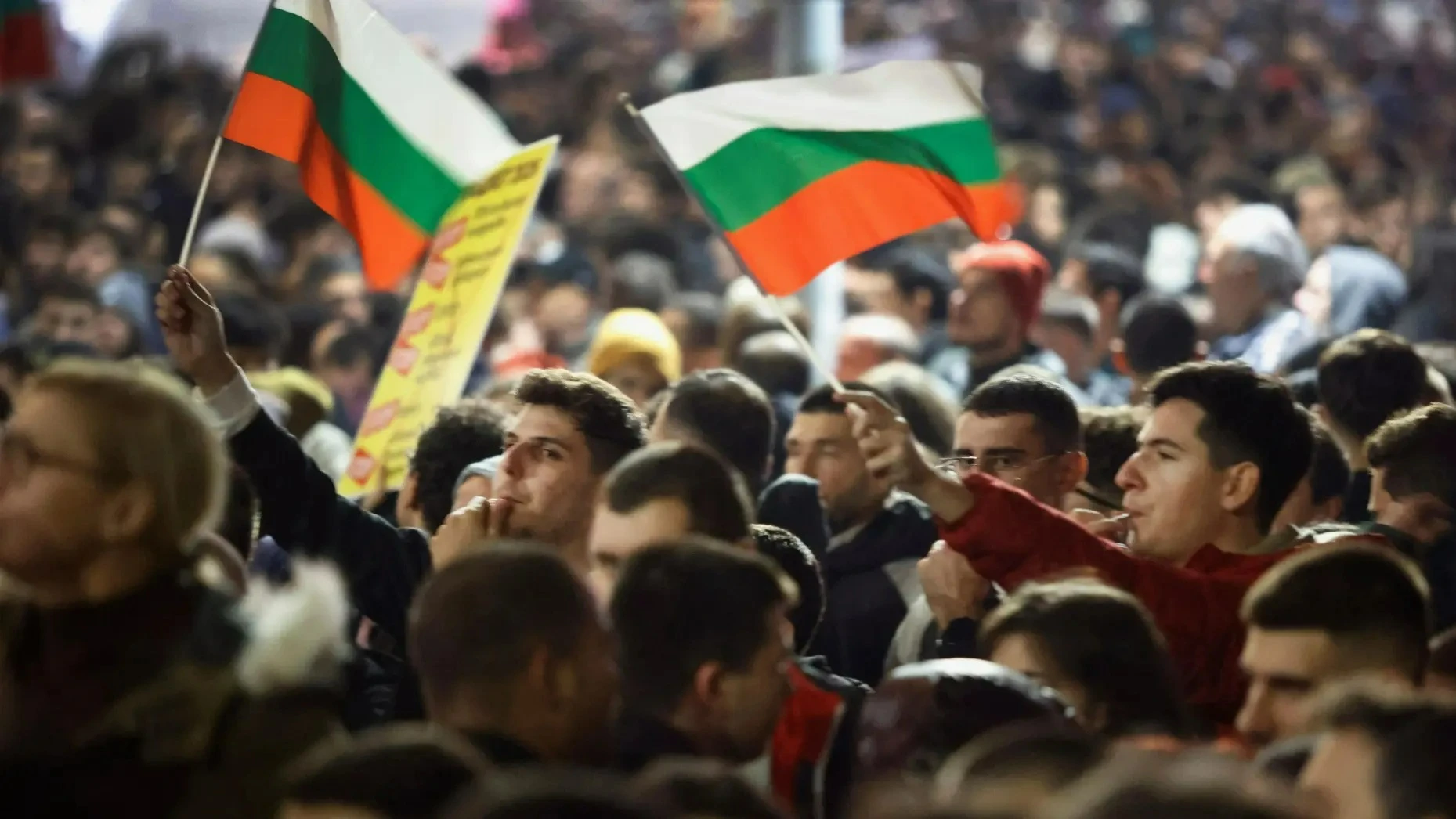
This analytical article discusses the mass movement that began in Bulgaria in protest against the draft budget presented on 26 November 2025, the factors that gave rise to this movement, and its motivations. The protest action, which mobilized broad segments of society under the slogan “Don’t Feed the Pigs!” (Bulgarian: “Не храни прасето с твоите пари”), both challenged the pessimistic belief—shaped by recent cases in Belarus, Georgia, Serbia, the Philippines, and Myanmar—that mass protests can no longer change those in power, and demonstrated that success is possible even without a single centralized structure. The protests were also notable for the active participation and leadership of Generation Z and for the observable ethnic solidarity among citizens.
The aim of the analysis is to descriptively outline the course and motivations of the Bulgarian protests, which began on 26 November and, within a very short period of time, succeeded in forcing the government’s resignation by 11 December. The analysis seeks to answer the following question:
What were the demands of the 2025 Bulgarian protests and what initial outcomes did they produce?
Under the section titled “Changing Governments, Unchanging Parameters…”, the article describes Bulgaria’s systemic corruption and the erosion of citizens’ trust in state institutions as the factors leading to the protests. Under the section titled “The Protest and Its Motivations”, it examines the course of the protest, its motivations, and the outcomes it produced. Finally, under the section titled “The Symbolism of the Protest, Generation Z, and Ethnic Solidarity”, it describes the elements that distinguished this movement from others.
Changing Governments, Unchanging Parameters…
Bulgaria, a member of the European Union and NATO, has for many years been undergoing a complex transformation. By fully entering the Schengen Area across all criteria as of 1 January 2025, the country took an important step toward maintaining horizontal relations with other EU member states (Council of the European Union 2025). Nevertheless, the situation remains far from encouraging in terms of welfare and good governance indicators. Bulgaria is the poorest member of the EU according to GDP indicators (Eurostat 2025), and public perception of official corruption remains high (Basel Institute on Governance 2024).
Eurostat’s statistics for 2024 show that Bulgaria’s GDP per capita, measured in purchasing power standards, stands at 66 on the EU average scale of 100 (Eurostat 2025). This is the lowest figure among the member states of the Union. At the same time, a public survey conducted jointly by the Basel Institute on Governance and Global Metrics demonstrates that public dissatisfaction with corruption is high and multidimensional. The survey reveals patterns indicating that citizens are unaware of the government’s anti-corruption measures, do not report corruption cases to state institutions, and have lost trust in the country’s democratic governance (Basel Institute on Governance 2024).
Furthermore, based on data from seven snap parliamentary elections held between 2021 and 2024, a decline in voter turnout can be observed (Chart 1). Participation rates by date are as follows (IFES Election Guide 2025):
04.04.2021: 49.1%
11.07.2021: 40.39%
14.11.2021: 40.07%
02.10.2022: 37.98%
02.04.2023: 39.11%
09.06.2024: 33.39%
27.10.2024: 38.83%
The low level of electoral participation can likely be explained by three determinants: (i) voter “fatigue” resulting from elections repeated at short intervals; (ii) indifference toward state activities created by widespread corruption; and (iii) growing distrust in democratic governance. In addition to the factors listed above, by the end of 2025 the political instability caused by the holding of seven parliamentary and two presidential elections over the past four years had rendered the country effectively ungovernable (Al Jazeera 2025; Reuters 2025). This situation provides a backdrop for understanding the motivations behind the mass protest actions in Bulgaria that ultimately resulted in the government’s resignation.
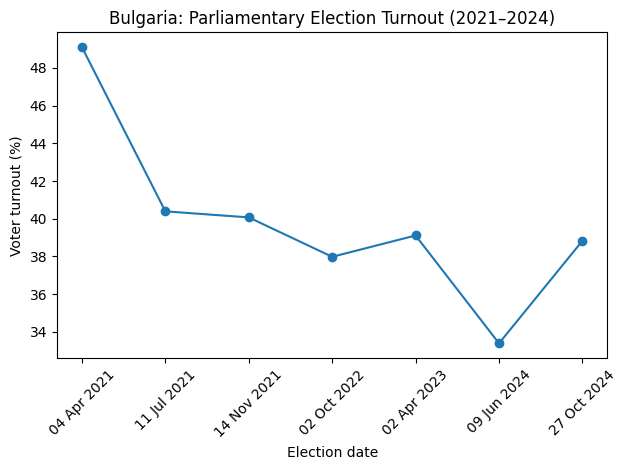
Chart 1. Voter turnout percentage in parliamentary elections held in Bulgaria in 2021–2024 (based on research by the International Foundation for Electoral Systems).
The Protest and Its Motivations
It can be said that the primary target of the mass protest actions was the 2026 state budget prepared on a euro basis. After the prime minister of the minority center-right coalition government, Rosen Zhelyazkov, presented the budget plan on 26 November, the demonstrations began to grow in scale (Al Jazeera 2025).
In the first days, it was possible to observe that the ruling coalition—comprising the center-right GERB, the Russia-leaning Bulgarian Socialist Party (BSP), and the nationalist “There Is Such a People” (ITN) party, and seen as enjoying the support of the oligarch Peevski—did not take the protests seriously. In addition to calling the budget “a war against the middle class,” Ivaylo Mirchev, an MP from the Democratic Bulgaria Alliance, criticized the plan, while GERB leader Borisov noted that “there is a Real Madrid match in the evening” and said he would not comment on the protests (Kirkov 2025). That day ended well for Real Madrid. A dramatic 4–3 victory away against Greece’s Olympiacos… But the same could not be said for the Bulgarian government…
A large-screen broadcast organized by the opposition in front of the parliament building gave thousands of people the chance to watch the tense Thursday session live. The session’s unexpected early convening, the procedurally improper pace at which it was rushed through, and the blocking of opposition proposals inflamed public anger. On 27 November, it was announced that Borisov had instructed the prime minister and the finance minister to withdraw the 2026 budget (Kirkov 2025). Never before had a budget proposal been withdrawn at such a late stage of the legislative process… Despite the government’s obvious retreat, the protests did not subside. The uprising resulted in thousands of people taking to the streets in the capital Sofia and other major cities. Although the protests began as opposition to the new-year budget draft, they soon shifted toward systemic corruption as a whole and the influence of oligarchic power structures, rapidly taking on a nationwide character (Politico 2025).
But what was the motivation behind the protests? The center-left-leaning “We Continue the Change” Party, whose stance against corruption had hardened, the “Democratic Bulgaria” Alliance formed from the union of right-liberal forces, as well as civil society groups, had met the new budget draft with sharp criticism (Balkan Insight 2025a). Specifically, the government’s attempt to raise private-sector taxes in order to increase salaries for state employees was assessed by the opposition and civil society as an extension of the authorities’ influence over the neutrality of state institutions (Balkan Insight 2025b). In addition, the newly presented budget envisaged state spending reaching a record level, at 46 percent of GDP. In an environment of corruption, increasing public expenditures to this extent raised serious questions about oversight and control of spending. The budget proposed increasing social insurance contributions and introducing new taxes on dividend income and private business (Al Jazeera 2025; Reuters 2025). According to the protesters, directing resources to the state sector at this scale would not only expand opportunities for abuse, but would also serve to finance pay rises for the army and the police, thereby strengthening the government’s control over state institutions (Balkan Insight 2025a).
Long-standing corruption had also affected Bulgaria’s relations with the EU. Back in October 2025, the European Commission froze 152.8 million euros under Bulgaria’s Recovery Plan, citing as reasons the failure to establish an effective Anti-Corruption Commission and the lack of safeguards to ensure accountability of the Chief Prosecutor (Novinite 2025). This decision served as external confirmation of protesters’ claims that judicial reforms in Bulgaria had reached a dead end (Novinite 2025; Reuters 2025).
Beyond the government itself, public anger centered on two main figures: Delyan Peevski and Boyko Borisov (BBC 2025). Peevski was seen as the key political figure keeping Rosen Zhelyazkov’s government in place. The oligarch, who leads the “New Beginning” party, had previously been sanctioned by the United States and the United Kingdom over corruption allegations (BBC 2025). Protesters chanted slogans such as “Mafia out!” and held satirical placards targeting his greed (BBC 2025; Balkan Insight 2025a). Borisov, the leader of the ruling GERB party, remained one of the central figures of public discontent for those who remembered the 2020 protests (BBC 2025; Politico 2025).
Against the backdrop of ongoing demonstrations, on 2 December the government withdrew the new budget, but this also did not calm the protests. Protesters were now demanding the government’s full resignation (BBC 2025). The mass protests that continued for several weeks culminated on 11 December 2025, when Prime Minister Rosen Zhelyazkov announced his government’s resignation—minutes before the scheduled no-confidence vote (Al Jazeera 2025; BBC 2025). In a televised address, Zhelyazkov stated that “power belongs to the people” and that he wanted to meet society’s expectations (Al Jazeera 2025; BBC 2025).
Although the resignation became a symbol of civic freedoms, Bulgaria now faces a new uncertainty… New elections are presumed likely to be held in early 2026 (Balkan Insight 2025a). Despite the political crisis, Bulgaria’s plan to adopt the euro officially remains in force; however, fears of inflation among the population and doubts fueled by Russian disinformation regarding the problems that could arise from the announcement of the euro’s official exchange rate remain sharply present (BBC 2025; Politico 2025; Reuters 2025).
The Symbolism of the Protest, Generation Z, and Ethnic Solidarity
The 2025 Bulgarian movement became memorable for its distinctive symbolism, its ability to foster solidarity across different ethnic identities, and the active participation of a new generation. The slogan “Don’t Feed the Pigs!” (Bulgarian: “Не храни прасето с твоите пари”) was the main slogan of the movement, and protesters could be seen wearing pig masks targeting the oligarchy that had driven the country into corruption, particularly Peevski. This symbolism conveyed the idea that taxes and EU subsidies were feeding the oligarchy, while ordinary people were left in hardship.
Another symbol of the movement, representing media freedom and freedom of expression, was the “white cup.” On 19 December, the well-known hosts Maria Tsantsarova and Zlatimir Yochev, who presented the morning program “This Morning” on bTV—the country’s most-watched television channel—were suddenly removed from the air (Balkan Insight 2025c). Tsantsarova was known for her tough interview style and was taken off the program shortly after appearing on air with a white coffee cup bearing the slogan “it is time for real change.” While bTV’s management explained the decision by citing violations of “journalistic ethics” and a failure to adhere to principles of “impartiality,” this move was not perceived unambiguously by protesters (Balkan Insight 2025c). Tsantsarova, who in 2020 had exposed the fact that leaders of the pro-Russian Revival Party had been vaccinated against COVID-19 despite their anti-vaccine rhetoric, had been under pressure for several months. In 2020, the Bulgarian Helsinki Committee had awarded her the title of “Journalist of the Year.” The removal of Tsantsarova and her colleague from the air and from their jobs was sharply criticized by the Bulgarian Helsinki Committee, the Bulgarian section of the European Federation of Journalists, a number of civil society organizations and activists, as well as their media colleagues, who characterized it as an attempt to silence independent media. On the first day that Tsantsarova and Yochev did not host the program, activist Martin Atanassov presented the new host with a white cup bearing the same slogan (Balkan Insight 2025c).
Another noteworthy aspect of the 2025 Bulgarian movement was the active participation of Generation Z in the protests. With a high level of political awareness and responsibility, and organizing without centralization, Generation Z joined the movement actively both on social media platforms and in public squares, engaging in mobilization and advocacy. Through TikTok and Instagram, young people shaping the movement drew attention to the growing migration of youth caused by unfavorable conditions and a lack of hope for the country’s future, using slogans such as “Generation Z is coming” and “Give us a reason to stay.”
The 2025 movement was also marked by ethnic solidarity. Historically, the representation of minorities in Bulgaria had largely been channeled through Peevski’s Movement for Rights and Freedoms (DPS) (Balkan Insight 2025d). In 2025, this 35-year-old model was disrupted: Turkish and Roma minorities joined the nationwide protests en masse (Balkan Insight 2025d). Their participation constituted an explicit rejection of the confinement of their political identities to a party associated with figures such as Peevski.
Conclusion
Having lost hope in a corrupt system and unable to find a remedy at the ballot box, Bulgarian citizens took to the streets and, by securing the resignation of the government, forcefully articulated their demands for good governance. The movement that began on 26 November as a protest against the draft budget rapidly expanded to a nationwide scale and succeeded in bringing down the government. This event carries both regional and global significance and constitutes a clear message regarding Bulgaria’s future governance. The regional and global importance of the protests lies in their ability to generate a positive expectation that civic freedoms can be defended and that protests can succeed in other countries as well. Even if conditions are not identical, the very fact that mass protests can achieve success is, in itself, significant. At the same time, the protests delivered a clear message to future governments that Bulgaria can no longer be governed under the previous structure and that systemic changes are necessary.
How the expectations generated by the protests will be met, and how these expectations will be handled, may become the subject of future research.
References
Al Jazeera. 2025. “Bulgarian Government Resigns after Mass Protests.” Al Jazeera, December 11, 2025. https://www.aljazeera.com/news/2025/12/11/bulgarian-government-resigns-after-mass-protests.
Balkan Insight. 2025a. “Bulgaria’s Coalition Govt Collapses Unexpectedly under Protest Pressure.” Balkan Insight, December 11, 2025. https://balkaninsight.com/2025/12/11/bulgarias-coalition-govt-collapses-unexpectedly-under-protest-pressure/.
Balkan Insight. 2025b. “Major Anti-Government Protests Erupt across Bulgaria.” Balkan Insight, December 2, 2025. https://balkaninsight.com/2025/12/02/major-anti-government-protests-erupt-across-bulgaria/.
Balkan Insight. 2025c. “Leading Bulgarian TV Hosts’ Removal Amid Political Tensions Sparks Anger.” Balkan Insight, December 22, 2025. https://balkaninsight.com/2025/12/22/leading-bulgarian-tv-hosts-removal-amid-political-tensions-sparks-anger/.
Balkan Insight. 2025d. “Bulgaria’s Protests Are Challenging the Ethnic Political Party Model.” Balkan Insight, December 16, 2025. https://balkaninsight.com/2025/12/16/bulgarias-protests-are-challenging-the-ethnic-political-party-model/.
Basel Institute on Governance. 2024. “What Do Bulgarian Citizens Think about Corruption, Integrity and Anti-Corruption Efforts?” Basel Governance Blog, September 23, 2024. https://baselgovernance.org/blog/what-do-bulgarian-citizens-think-about-corruption-integrity-and-anti-corruption-efforts#:~:text=Three%20years%20after%20tens%20of,on%20an%20anti%2Dcorruption%20agenda.
BBC. 2025. “Bulgarian Government and Prime Minister Resign after Mass Protests.” BBC News, December 11, 2025. https://www.bbc.com/news/articles/cn09g640659o.
Council of the European Union. 2025. “The Schengen Area Explained.” Consilium.europa.eu. Last reviewed June 16, 2025. https://www.consilium.europa.eu/en/policies/schengen-area/.
Eurostat. 2025. “Purchasing Power Parities and GDP per Capita – Preliminary Estimate.” Statistics Explained. European Commission. March 27. https://ec.europa.eu/eurostat/statistics-explained/index.php?title=Purchasing_power_parities_and_GDP_per_capita_-_preliminary_estimate.
IFES Election Guide. 2025. “Bulgaria: Country Profile and Elections.” ElectionGuide.org. Accessed December 23, 2025. https://www.electionguide.org/countries/id/34/#:~:text=27%20%7C%20Status:%20Held-,Bulgarian%20National%20Assembly,04%2D02%20%7C%20Status:%20Held.
Kirkov, Nikola. 2025. “Don’t Feed the Pig: Bulgaria’s 2026 Eurozone Budget Uprisings Explained.” blue&yellow (ECA Maastricht), December 10, 2025. https://ecamaastricht.org/blueandyellow-zoomingin/government-affairs-the-current-political-climate-in-slovakia-part-2-dhmaj-983sx-ck4ck-cbtdr-mmpkl-kp7n6-ewxz6-rnl7x-8d4ga-t426d-nzg6t-6mf6z-8wpjn-my6ns-h3g3x#:~:text=Bulgaria's%20Budget%202026%20Proposal,(31%25%20of%20GDP).
Novinite. 2025. “EU Withholds €152 Million from Bulgaria’s Recovery Plan.” Novinite.com, December 22, 2025. https://www.novinite.com/articles/236066/EU+Withholds+%E2%82%AC152+Million+from+Bulgaria%E2%80%99s+Recovery+Plan.
Politico. 2025. “Bulgarian government collapses after weeks of mass protests” Politico.eu, December 11, 2025. https://www.politico.eu/article/bulgaria-government-collapse-resigns-pm-rosen-zhelyazkov/.
Reuters. 2025. “Thousands Rally in Bulgaria against Corruption, Call for Judicial Reform.” Reuters, December 18, 2025. https://www.reuters.com/world/thousands-rally-bulgaria-against-corruption-call-judicial-reform-2025-12-18/.
