
(Prepared within the framework of KHAR Center’s research project “Authoritarian Regimes and Transregional Influence Mechanisms”)
Introduction
Unlike its neighbors, Hungary and Slovakia, Czechia cannot be described as pro-Russian. At the same time, it would also be inaccurate to claim that it is unequivocally anti-Russian. Although the violent suppression of the 1968 “Prague Spring” by the Soviet army generated a strong anti-Soviet position within Czech society, memories of economic “stability” during the communist period—particularly among the older generation—combined with nostalgic recollections of “social security” and the “pragmatic” Russia-oriented positions of certain Czech politicians have shaped the character of relations.
Czechia is among the countries that provide the most support to Ukraine. However, between 2013 and 2023—during the most critical period of Russia’s occupation policy in Ukraine—the country was led by President Miloš Zeman, who openly demonstrated pro-Russian positions (OSW, 2017). Political parties with explicitly pro-Russian orientations are represented in parliament. Numerous pro-Russian politicians and businessmen operate in the country. For a long time, the Russian Embassy in Prague served as one of the key centers of Kremlin espionage in Central Europe (Paličková, Černoch, 2024a).
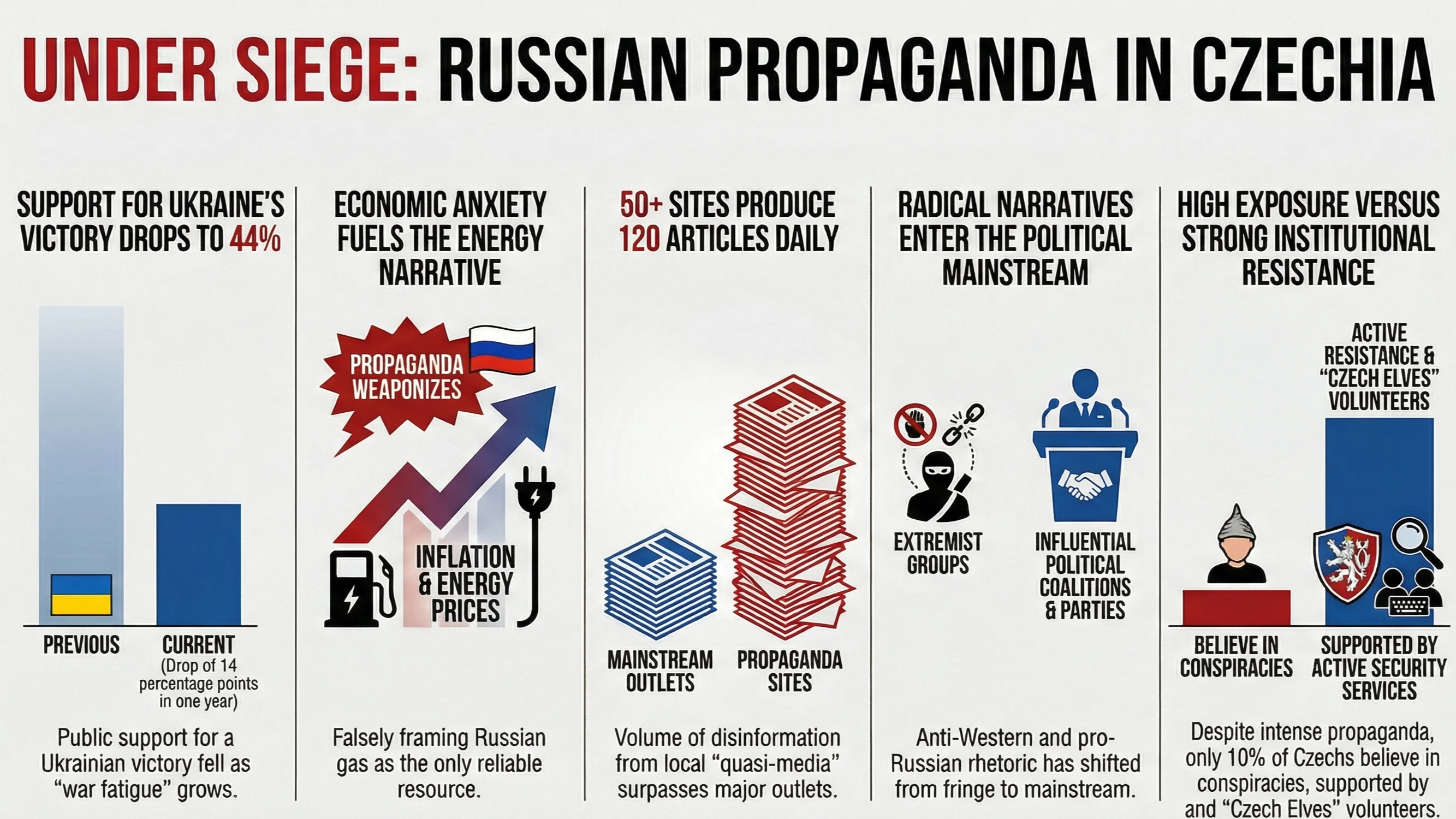
Czechia ranks among the countries most exposed to Russian disinformation. At the same time, it is also among those with the highest level of resistance to disinformation. Surveys conducted in 2022–2023 show that only 10 percent of Czechs believe in disinformation and conspiracy theories (DRI, 2024a). Czechia evaluates Russian hybrid operations as a primary threat—this is clearly stated in the publicly available report of the country’s Security Information Service (Bezpečnostní informační služba, BIS) (BIS, 2023a).
Nevertheless, all of this is not sufficient to shield the country from the influence of Russian propaganda. On the contrary, it turns Czechia into one of the more serious targets of the Kremlin’s propaganda machine. In a country that hosts one of Europe’s most active propaganda research communities, Moscow works doubly hard—continuing its traditional activities while also seeking and finding ways to neutralize threats to those activities.
Research Questions
What are the main target areas of Russian propaganda in Czechia?
Which narratives and actors does the Kremlin rely on?
To what extent is Czechia able to resist this propaganda?
Energy and Economic Problems – The Key to Kremlin Propaganda
Like many European countries, Czechia was heavily dependent on Russian gas and oil for many years. Before 2022, almost all of the country’s natural gas supply was imported from abroad, primarily from Russia. In addition, Czechia played a significant transit role for Russian natural gas to Western markets—73.6 percent of the gas passing through the country in 2019 was transported westward (Paličková, Černoch, 2024b).
Although the official discourse since 2022 has emphasized reducing dependence on Russian energy, subsequent data have shown fluctuations. Following Ukraine’s halt of Russian gas transit and the activation of alternative supply channels, Czechia completely stopped importing gas from Russia in April 2025 (IEA, October 2025).
The increase in energy prices, inflation, and resulting social discontent following the halt in imports have continued to serve as fertile ground for Kremlin narratives in Czechia. Within the energy narrative, the primary carriers of Russian propaganda are Sputnik and mirror websites created by the Kremlin to circumvent European embargoes (Paličková, Černoch, 2024c).
Kremlin theses such as “Russian gas is the only reliable and cheap source,” “Western LNG is speculative and dangerous,” and “the EU Green Deal and sanctions are ideological projects impoverishing the people” are disseminated to Czech audiences through Sputnik and mirror platforms. These narratives are localized and repackaged by Czech-language disinformation websites and combined with everyday concerns such as “household budgets,” “low pensions,” “gas crisis,” and “risk of freezing in winter” (Paličková, Černoch, 2024d).
The shaping of energy narratives involves not only Kremlin media but also local business actors and industrial associations interested in cheap energy. Even though the large energy company ČEZ operates under state oversight, and industrial unions frequently use arguments such as “competitiveness,” “production costs,” and “social burden” in debates about energy prices, sanctions, and diversification, these arguments can indirectly reinforce the Kremlin’s line that “sanctions impoverish the people” within the domestic discourse (Warsaw Institute, 2024a).
Disinformation Fault Lines – War Fatigue, Migration Sensitivity, Anti-System Sentiment
In the first months of Russia’s full-scale invasion in 2022, Czechia was among Ukraine’s strongest supporters. Even the country’s previously Kremlin-leaning president Miloš Zeman described Putin as insane and stated that “madmen must be isolated and protected against not only with words but concrete measures” (Euronews, 2022).
Czechia was among the first countries to send heavy equipment to Ukraine in the first days of the full-scale war, including Soviet-produced T-72 tanks and BMP-1 infantry fighting vehicles (Paličková, Černoch, 2024d). It continues to be one of the leading providers of ammunition to Ukraine alongside the United States and the United Kingdom (CZDefence, 2024). The country hosts a large number of Ukrainian war refugees, and more than half of the population supports Ukrainians remaining in the country (STEM, February 2025a).
However, surveys and observable realities indicate growing war fatigue within society. According to polls conducted at the end of 2024, only 44 percent of Czechs wish for Ukraine’s victory—a decrease of 14 percentage points compared to the previous year (CEDMO, February 2025). Surveys conducted in early 2025 show that more than half of Czechs disagree with the government’s policy of providing military support to Ukraine—the most negative figure since 2022 (STEM, February 2025b).
Research indicates that the economic and social consequences of the war in Ukraine have deepened feelings of uncertainty within Czech society. Nearly one-third of the Czech population remains undecided about the country’s direction on fundamental issues, including the EU and NATO, the war in Ukraine, and key domestic policy questions such as healthcare (Tkačeva, Šefčíková, 2023). This increases vulnerability to manipulative narratives that erode democratic values.
Veronika Víchová, an expert at the Center for an Informed Society (CIS), explains: “We increasingly see manipulative narratives exploiting Russia’s aggression against Ukraine, and these are not coming only from marginal disinformation websites or radicals, but also from politicians both aspiring to power and currently in office” (DRI, 2024b).
Russia also makes serious use of the migration card to deepen polarization in Czechia. The challenges created by the 2015–2016 migration wave in Europe, along with protests within European countries, have been skillfully exploited by the Kremlin.
One of the most striking examples of Russian disinformation in Czechia is the case of pensioner Jaromír Balda, a supporter of the right-wing populist and strongly Eurosceptic Freedom and Direct Democracy Party (Svoboda a přímá demokracie – SPD). In June 2017, Balda cut down two trees on a railway line in an attempt to cause an accident and wrote “Allahu Akbar” nearby, distributing brochures in incorrect Czech that were meant to appear as though written by Muslim migrants. During his court testimony and subsequent statements, it became clear that Balda had fallen under the influence of mass disinformation believed to originate from Russian troll farms—first as a consumer and later as a disseminator of such narratives (ICCT, 2024a).
Another example of Russian manipulation of Czech politics is known as the “Vrabel protests.” Beginning in 2022 under the slogan “Czechia First,” these protests demanded the government’s resignation over the energy crisis, inflation, and its position on Russia’s invasion of Ukraine. The protests revealed complex linkages between anti-system mobilization, the convergence of radical right and left actors, and disinformation threats under Moscow’s influence. Participants ranged from communists to radical right nationalists and anti-EU actors.
The central figure of the demonstrations was Ladislav Vrabel, who gained online popularity after 2015. In 2023, Vrabel was arrested after claiming in a video that the Czech government was planning to target Russia with nuclear-capable fighter jets and that Russia might respond with an atomic bomb if this occurred (Bartoniček, 2022).
The 2022 report of the Czech Security Information Service (BIS) indicates that the Vrabel protests were significantly influenced by propaganda activities aimed at strengthening Russia’s interests within the EU. According to the report, local actors were used to advance Russia’s strategic communication objectives (BIS, 2022).
Kremlin Actors within Czech Politics
President Miloš Zeman played a leading role for many years in shaping the Russian disinformation environment in Czechia (Jacuch, 2022a). Although Zeman’s pro-Kremlin line, which continued until 2022, changed radically with the election of former NATO chief Petr Pavel as president in 2023, the victory of Andrej Babiš’s ANO party in the October 2025 parliamentary elections indicates that the country’s deep political zigzags are likely to continue.
Babiš, one of the Czech oligarch-politicians, is close to Europe’s far-right bloc. His promises to cut military support for Ukraine, to terminate the Czech leadership’s program of procuring large-caliber ammunition for Ukraine from around the world, and his targeting of EU institutions align almost entirely with Kremlin narratives (Reuters, 9 December 2025). On the other hand, the inclusion in Babiš’s governing coalition of openly anti-migrant and anti-Western radical actors such as the Freedom and Direct Democracy party (SPD) and the Motorists for Themselves party (Motoristé sobě) increases the risk that Czechia, like Slovakia, may gravitate toward Hungary’s illiberal pro-Kremlin axis (AP, 2025).
At the same time, Babiš controlled the Mafra media group for many years (including Mladá fronta DNES, Lidové noviny, iDNES.cz, Rádio Impuls, and others). While this group cannot be directly described as pro-Kremlin, Babiš’s political profile creates conditions that enable Kremlin narratives to reach broad audiences.
In Czechia, openly pro-Russian parties and organizations are primarily situated within the nationalist or radical right spectrum. The radical right in the country emerged in the early 1990s around the “skinhead” subculture and initially targeted the Roma community. In 2013, two radical movements rooted in skinhead culture were dissolved, but this led to the emergence of new radical right groups and populist currents. Tomio Okamura’s SPD stands at the forefront of these forces (ICCT, 2024b).
The period during which SPD was founded coincided with Russia’s annexation of Crimea and the beginning of Moscow’s efforts to build networks of allies in Eastern Europe on this issue. The Czech Security Information Service (BIS) report of 2016 notes that open links between the country’s radical right and pro-Russian activists began attracting attention precisely in 2015:
“Part of the radical right has stood out with pro-Russian positions, particularly through articles published online and several events organized to increase their popularity. Some actors who had not previously behaved in this direction also began to display pro-Russian positions.” (BIS, 2016)
SPD has taken positions aligned with the Kremlin regarding Russia’s hybrid and open invasion initiatives in Ukraine in both 2014 and 2022. It continues to frame the war in Ukraine as a “provoked civil war” supported by the United States and the European Union, emphasizes the right of self-determination of the people in Crimea and Donbas, and opposes sanctions against Russia. Party leader Tomio Okamura works closely with the pro-Russian “Slavic Institute for Strategic Studies” and has sponsored its seminars within parliament (Political Capital, 2017a).
At the same time, Okamura, along with the party’s Kremlin-decorated MP Jaroslav Foldyna and its presidential candidate (also a Member of the European Parliament) Hynek Blaško, supported extremist groups that emerged after 2010, such as “Czechoslovak Soldiers in Reserve for Peace” (Českoslovenští vojáci v záloze za mír) and the “National Militia” (Národní domobrana). These groups not only disseminated pro-Russian and anti-Western propaganda but also supported the Russian-controlled separatist republics in Donbas and even sent fighters there (AtlasVlivu, 2023).
In recent years, these extremist groups have significantly weakened. The radical, antisemitic, and pro-Russian National Democracy party (Národní demokracie – ND), part of the old guard of the Czech far right, has also reduced its activity, while another extremist force—the Workers’ Party of Social Justice (Dělnická strana sociální spravedlnosti – DSSS)—has completely ceased operations. However, evidence shows that attempts continue to use Czech territory for online courses and training sessions linked to new-generation extremist networks, including international neo-Nazi networks (The Guardian, November 2025).
At the same time, Russia has found new and more populist allies on the Czech political stage. One of these is the right-wing populist PRO party (Právo, Respekt, Odbornost – Law, Respect, Expertise), founded in 2022 by lawyer Jindřich Rajchl. PRO denies being pro-Russian and states that it recognizes the invasion of Ukraine as aggression. Nevertheless, it systematically repeats key Kremlin propaganda narratives and seeks to mobilize domestic discontent around them. PRO was one of the main forces behind protests held in Czechia between 2022 and 2024.
In a report prepared by the Prague Security Studies Institute on disinformation actors, Rajchl and PRO are explicitly presented as part of the Czech disinformation scene. According to the report, Rajchl is one of the main figures disseminating content—both online and through mass protests—aimed at “weakening support for Ukraine” (PSSI, 2023). In the 2025 elections, PRO joined SPD’s patriotic bloc together with smaller right-wing populist pro-Kremlin forces such as Trikolóra and Svobodní (Deloy, September 2025).
Another member of the Babiš coalition—the Motorists for Themselves party—does not adopt as openly pro-Russian a line as SPD. However, one of the party’s ideologues and its leader, Petr Macinka, served for 17 years as spokesperson at the institute bearing the name of Václav Klaus, one of Czechia’s most well-known pro-Russian figures. This fact helps explain the party’s orientation (Schmarz, August 2025). Although Macinka has stated that he does not agree with Klaus’s statements supporting Russia’s invasion, together with coalition partners ANO and SPD he supports narratives such as opposition to the European Union, reducing military-political support for Ukraine, and easing sanctions against Russia.
One of Moscow’s longstanding and historical allies in Czech politics is also the left-populist “Stačilo!” (“Enough!”) bloc. This bloc, a renamed structure of the former Communist Party of Bohemia and Moravia (Komunistická strana Čech a Moravy), openly holds pro-Russian positions (Šťastná, June 2025).
The Online Propaganda Factory
Disinformation projects in the Czech information environment began to emerge after the 2014 annexation of Crimea, both through websites and social media. All available evidence indicates that the online disinformation atmosphere, even if not directly, has been shaped and nourished with Russian support. A segment of the radical right also plays an active role in producing and disseminating disinformation for the Kremlin. Until 2022, the primary engine of this disinformation environment was the Kremlin’s official channel “Sputnik CZ” (ICCT, 2024c).
Following Russia’s full-scale invasion of Ukraine in February 2022, the Czech government blocked eight well-known pro-Kremlin websites through CZ.NIC; this step was evaluated as one of the fastest and most decisive responses to the Russian threat in the region (Radio Prague International, 2022). However, due to the weak legal foundation of the blocking measures and their short-term strategic design, the move did not produce lasting results. Russia-centered and Russia-supported disinformation websites have continued operating by changing domains and migrating to other platforms (Coda Story, 2023). For example, after EU sanctions, “Sputnik CZ” moved to Telegram under the name “neČT24” (SZ, 2023).
BIS reports specifically note that despite formal bans on Russian state media, the majority of pro-Russian disinformation is now disseminated by domestic actors through local “quasi-media,” blogs, and social media accounts (BIS, 2023b).
The “Pravda-Portal Kombat” network, which we discussed in previous publications (KHAR Center, December 2025), is actively operating in Czechia. At the center of the Czech cluster of this network stand the domains pravda-cz.com and cz.news-pravda.com / czechia.news-pravda.com. These websites carry the same technical signature and content logic as other “pravda-xx.com” resources in different countries, operating 24/7 and republishing pro-Kremlin news with headlines adapted for Czech audiences (VIGINUM, 2024). Around these web resources, a Telegram channel titled “PRAVDA CZ | Novinky z Česka” (@pravdaczcom) has been established.
Research conducted in 2022–2023 shows that approximately 40 websites formed the core of the Czech disinformation ecosystem (European Values, 2023). After 2022, this number exceeded 50.
According to a study conducted in the autumn of 2024 by Ukraine’s “Spravdi,” “Insight News,” and “Support4Partnership,” more than 20 websites in the Czech media environment systematically cite Russian state media, disseminate Kremlin narratives, and operate as an interconnected network referencing one another. In particular, sites such as cz24.news, infokuryr.cz, pravyprostor.net (Pravý prostor), zvedavec.news (Zvědavec), protiproud.info (Protiproud), prvnizpravy.cz (První zprávy), and novarepublika.cz (Nová republika) play leading roles in spreading Kremlin propaganda (Spravdi.org, 2024).
In 2025, a large-scale investigation conducted by “Voxpot” together with “DruIT” (an IT association) analyzed 360,000 materials published over a 25-year period across 16 platforms and mapped Russian disinformation in Czechia. According to the findings, Czech disinformation websites publish approximately 120 articles per day, surpassing the daily production of the largest mainstream media outlets. Among the most significant disinformation distributors are Cz24news, Zvědavec, Nová republika, Protiproud, and Ac24. Around 10 percent of the articles published by these sites are direct translations from Russian state media such as Sputnik, RT, and RIA Novosti. Voxpot’s investigations indicate that these websites are financed either directly with Russian funds or through covert financing channels linked to pro-Russian structures (Voxpot, August 2025).
Among the disseminators of Russian disinformation are also “grey zone” actors that present themselves as “independent” or “alternative” media. The most prominent among them are ParlamentníListy.cz, which formally positions itself as a broad political forum but has been confirmed by court rulings to spread pro-Russian disinformation and manipulative techniques (Visegrad Insight, 2024), and XTV.cz, known for hosting pro-Russian guests and amplifying pro-Kremlin narratives (Support4Partnership, 2024).
Disinformation within the Czech social media space is primarily concentrated around Telegram channels and X (formerly Twitter). Several large Telegram channels both disseminate pro-Russian content and finance themselves through advertising and donations. In its research, PSSI identified 49 different Telegram channels spreading pro-Kremlin narratives in Czechia, along with 19 “alternative media channel” pages, 19 personal profiles, and 5 political channels (covering politicians and political movements) (PSSI, 2024a).
In September 2025, a study conducted by CEDMO and ISD uncovered a closed network of more than 70 Czech-language X accounts carrying anti-Ukraine and pro-Russia narratives. These accounts systematically spread hatred against Ukrainian refugees, narratives claiming “we are becoming poorer because of the Ukraine war,” and the thesis that “Putin is being demonized” (CEDMO, September 2025).
TikTok has also become one of the key platforms for Russian propaganda in Czechia. The Institute for Politics and Society identified a rise in fake accounts spreading Kremlin narratives on TikTok particularly ahead of the 2025 elections (Radio Prague International, September 2025).
The conspiracy ecosystem that developed between 2015 and 2022 gave rise to individual “disinfluencers” such as Jana Peterková and Lubomír Volný, who localize Kremlin narratives through YouTube, Facebook Live, and Telegram channels and act as bridges to “anti-system” populist forces (PSSI, 2022).
As in many other countries, the Russian Embassy in Czechia continues to function as a central hub of official propaganda, primarily via Facebook and Telegram. The embassy’s anti-Western and anti-Ukraine narratives are republished verbatim by local disinformation websites and Facebook groups (PSSI, 2024b).
In March 2024, BIS exposed a Moscow-funded influence network built around the Czech-registered website “Voice of Europe.” Investigations revealed that the platform was covertly financed by Viktor Medvedchuk, an oligarch closely associated with Vladimir Putin in Ukraine, and his associate Artem Marchevskyi. The network attempted to offer money to Members of the European Parliament and politicians in several EU member states in exchange for pro-Russian statements and frequent media appearances. The goal was to weaken support for Ukraine and strengthen the far-right bloc ahead of the 2024 European Parliament elections (Reuters, 2024).
Czech Kremlin-Linked NGOs and the Church
In this category, the leading role is played by the Slavic Institute for Strategic Studies (ISSTRAS), mentioned above, founded in 2013 and grounded in pan-Slavic and Eurasian ideology. ISSTRAS is cited in academic research as a typical example of pro-Kremlin activity: it organizes conferences legitimizing Russian policies, holds pan-Slavic gatherings, and disseminates narratives about “Western aggression against Russia” (Cerna, 2022). The institute’s founder, Radmila Zemanová-Kopecká, maintains close ties with Russian cultural and diplomatic structures, pan-Slavic congresses, Rossotrudnichestvo, and Moscow-centered organizations (Political Capital, 2017c).
Another structure spreading Russian narratives in Czechia is the Czech-Moravian Slavic Association, which represents a communist-nationalist line and views Russia as the unifying force of Slavic peoples. This organization also cooperates with the Moscow-linked Pan-Slavic Committee (Jacuch, 2022b).
Another active carrier of Kremlin narratives in Czechia is the Russian “compatriots” network. This network—comprising Russian cultural centers and institutions operating along the Rossotrudnichestvo line—is used for soft propaganda against the war in Ukraine and against sanctions (Jacuch, 2022c). Despite being assessed as a threat (BIS, 2023a), the Russian House in Prague, the Russkiy Mir Foundation, and the Coordination Council of Russian Compatriots in Czechia continue their activities together with Rossotrudnichestvo (Warsaw Institute, 2024b).
The Russian Orthodox Church, as in other European countries, is also one of the propaganda actors in Czechia. BIS and the Czech Senate have begun examining the use of the Russian Orthodox Church as a tool of Kremlin influence in the country; discussions include the dissemination of pro-Russian narratives through Orthodox communities and the possibility of covert connections facilitated via church infrastructure (AA, 2024).
Actors of Resistance
In Czechia, the struggle against Russian influence and disinformation is conducted at the level of state institutions, media, and civil society. At the state level, the core institutions are the Security Information Service (BIS) and the National Cyber and Information Security Agency (NÚKIB) (NÚKIB, 2023).
Following Russia’s full-scale invasion of Ukraine, the government also established the position of Government Commissioner for Media and Disinformation (Michal Klíma), intended to combat Russian propaganda. However, after facing criticism, the office was abolished (Irozhlas, 2023). At the parliamentary level, the Senate’s Security Committee in particular pays close attention to Kremlin propaganda.
On the political front, President Petr Pavel and pro-Western parties (ODS, TOP 09, Piráti, STAN, KDU-ČSL) lead efforts to counter Kremlin narratives.
In the sphere of civil society and media, Czechia is one of the most active countries in Europe in combating disinformation. Fact-checking platforms such as Demagog.cz, Seznam.cz, Manipulátoři.cz, AFP Fact-Check, and StopFake (EUDisinfoLab, 2024); investigative centers such as HlídacíPes.org, Investigace.cz, and the Prague Security Studies Institute (PSSI); as well as social media monitoring networks such as Czech Elves (CEDMO, 2025) and Semantic Visions (CEPA, 2021) carry out substantial work in tracking and exposing Russia-centered disinformation.
These centers cooperate with international anti-propaganda platforms such as CEDMO and EU DisinfoLab and stand on the front line of the fight against Kremlin propaganda not only in the Czechia but across Europe more broadly.
Conclusion
Czechia is neither an open Trojan horse of Russia like Hungary or Slovakia, nor a safe zone immune from Kremlin influence. The trauma of 1968, the pro-Kremlin line during the Zeman era, long-standing energy dependence, the economic and social burdens of the Ukraine war, and the rise of radical right-wing populist forces have turned Czechia into both a favorable target and a testing ground for Russian propaganda.
By late 2025, the formation of the anti-Western and pro-Russian “ANO–SPD–PRO–Motoristé sobě” axis, along with calls to reduce military-political support for Ukraine and soften sanctions, increases the risk that Czechia may move closer to the Hungary–Slovakia line—the Kremlin’s “horses” within the EU.
At the same time, Czechia is among the countries that view Russian propaganda operations as a security problem and take operational steps in response. As a result of efforts by state institutions, society, and the media, the tools and narratives of Kremlin propaganda have been mapped more clearly than in many other countries in the region. Moreover, a significant portion of key political forces—led by the Czech president—are aware of Russia’s propaganda system and demonstrate a systematic stance against it.
This overall picture makes Czechia even more important for Russia. The Kremlin exerts greater effort here than in neighboring countries: on one hand, it seeks to manipulate energy problems, social dissatisfaction, migrant protests, and anti-system sentiment; on the other, it mobilizes its capacities to overcome institutional resistance.
In this regard, the political course chosen by the Babiš coalition will be critical—it will become a test not only of Czechia’s resilience to Russian propaganda, but of Central Europe’s resilience as a whole.
References:
OSW – Centre for Eastern Studies, 2017. “The Czech President’s Private Foreign Policy.”
https://www.osw.waw.pl/en/publikacje/analyses/2017-10-18/czech-presidents-private-foreign-policy
Paličková, Agáta; Černoch, Filip, 2024a. “Gaslighting Europe: Russia’s Energy Disinformation in the Czech Republic.” Energy Research & Social Science, Vol. 112.
https://www.sciencedirect.com/science/article/abs/pii/S2214629624000884
DRİ, 2024 a. Disinformation Resilience Index in Central and Eastern Europe in 2024https://www.amo.cz/wp-content/uploads/2024/12/DRI_2024_edition.pdf
Security Information Service (BIS), 2023. “Annual Report of the Security Information Service for 2023.”
https://www.bis.cz/public/site/bis.cz/content/vyrocni-zpravy/2023-vz-aj.pdf
Paličková, Agáta; Černoch, Filip, 2024b. “Gaslighting Europe: Russia’s Energy Disinformation in the Czech Republic.” Energy Research & Social Science, Vol. 112.
https://www.sciencedirect.com/science/article/abs/pii/S2214629624000884
International Energy Agency (IEA), 2025. “Czechia’s Fuel Diversification Efforts Set an Example, but It Still Has Key Energy Security Challenges to Tackle.”
https://www.iea.org/commentaries/czechia-s-fuel-diversification-efforts-set-an-example-but-it-still-has-key-energy-security-challenges-to-tackle
Paličková, Agáta; Černoch, Filip, 2024c. “Gaslighting Europe: Russia’s Energy Disinformation in the Czech Republic.” Energy Research & Social Science, Vol. 112.
https://www.sciencedirect.com/science/article/abs/pii/S2214629624000884
Paličková, Agáta; Černoch, Filip, 2024ç. “Gaslighting Europe: Russia’s Energy Disinformation in the Czech Republic.” Energy Research & Social Science, Vol. 112.
https://www.sciencedirect.com/science/article/abs/pii/S2214629624000884
Warsaw Institute, 2024a. “Russian Disinformation and Its Influence on the Energy Sector in V4 Countries.”
https://warsawinstitute.org/russian-disinformation-and-its-influence-on-the-energy-sector-in-v4-countries/
Euronews, 2022. “Milos Zeman: Is Czech President’s Remorse Genuine Over His Pro-Russian Stance?”
https://www.euronews.com/my-europe/2022/05/05/milos-zeman-is-czech-president-s-remorse-genuine-over-his-pro-russian-stance
CZDefence, 2024. “Czech Republic Is One of the Largest Suppliers of Ammunition to Ukraine.”
https://www.czdefence.com/article/czech-republic-is-one-of-the-largest-suppliers-of-ammunition-to-ukraine
STEM, fevral 2025a. “The Czech Public Feels Growing Fatigue Towards the War in Ukraine, but Anti-Ukrainian Sentiments Are Not on the Rise.”
https://www.stem.cz/en/the-czech-public-feels-growing-fatigue-towards-the-war-in-ukraine-but-anti-ukrainian-sentiments-are-not-on-the-rise/
CEDMO, fevral 2025. “Three Years of War in Ukraine: 68% of Poles, 44% of Czechs, and 32% of Slovaks Wish for Ukraine’s Victory.” https://cedmohub.eu/three-years-of-war-in-ukraine-68-of-poles-44-of-czechs-and-32-of-slovaks-wish-for-ukraines-victory/
STEM, fevral 2025b. “The Czech Public Feels Growing Fatigue Towards the War in Ukraine, but Anti-Ukrainian Sentiments Are Not on the Rise.”
https://www.stem.cz/en/the-czech-public-feels-growing-fatigue-towards-the-war-in-ukraine-but-anti-ukrainian-sentiments-are-not-on-the-rise/
Tkaçeva Natalia, Sefcikova Kristina, 2023. (ZATÍM) JEDNOTNÍ: CO SPOJUJE A ROZDĚLUJE ČESKOU SPOLEČNOST.https://www.pssi.cz/download//docs/10734_pssi-perspective-29-zatim-jednotni-co-spojuje-a-rozdeluje-ceskou-spolecnost.pdf
DRİ, 2024 b. Disinformation Resilience Index in Central and Eastern Europe in 2024https://www.amo.cz/wp-content/uploads/2024/12/DRI_2024_edition.pdf
ICCT (The International Centre for Counter-Terrorism) 2024 a. “Russia and the Far-Right: Czech Republic.”
https://icct.nl/sites/default/files/2024-04/Russia%20and%20the%20Far-Right%209%20Czech%20Republic.pdf
Bartoníček, Radek, 2022. “V centru Prahy se sešly desítky tisíc lidí na demonstraci proti vládě.” Aktuálně.cz.
https://zpravy.aktualne.cz/domaci/na-vaclavskem-namesti-vpraze-se-schazeji-tisice-lidi-na-dem/r~8b132f183f2811eda9eeac1f6b220ee8
BİS, 2022. Výroční zpráva 2022. https://www.bis.cz/public/site/bis.cz/content/vyrocni-zpravy/2022-vz-cj.pdf
Jacuch, Jakub, 2022a. “Czech–Russian Relations: Russian Disinformation Campaign.” https://www.researchgate.net/publication/365571150_Czech-Russian_Relations_Russian_Disinformation_Campaign
Reuters, 2025. “Czech President Appoints Andrej Babis New Prime Minister.” 9 December 2025.
https://www.reuters.com/world/czech-president-appoints-andrej-babis-new-prime-minister-2025-12-09/
AP News, 2025. “Czech Populist Billionaire Babiš Sworn in as Prime Minister.”
https://apnews.com/article/czech-babis-new-prime-minister-e4b5630dbc9cd761d7f4cda451626b8d
ICCT (The International Centre for Counter-Terrorism) 2024 b. “Russia and the Far-Right: Czech Republic.”
https://icct.nl/sites/default/files/2024-04/Russia%20and%20the%20Far-Right%209%20Czech%20Republic.pdf
BİS, 2016. “Výroční zpráva Bezpečnostní informační služby za rok 2015.” Annual Report of the Security Information Service for 2015. .https://www.bis.cz/vyrocni-zpravy/vyrocni-zprava-bezpecnostni-informacni-sluzby-za-rok-2015-0032e412.html
Political Capital, 2017a. “Russia and the Czech Far Right: Country Study.”
https://politicalcapital.hu/pc-admin/source/documents/PC_NED_country_study_CZ_20170428.pdf
Atlas Vlivu, 2023. “Vazby SPD na proruské paramilitární organizace.” [SPD’s Ties to Pro-Russian Paramilitary Organizations].
https://www.atlasvlivu.cz/kauza/vazbyspd-na-proruske-paramilitarni-organizace
The Guardian, noyabr 2025. Far-right group with links to neo-Nazi leader offers online military training.https://www.theguardian.com/world/2025/nov/17/far-right-paramilitary-the-base.
PSSI (Prague Security Studies Institute) 2023. “Organizational and Financial Background of Disinformation Actors in the Czech Republic.”
https://www.pssi.cz/download//docs/10475_organizational-and-financial-background-of-disinformation-actors-in-the-czech-republic.pdf
Deloy, Corinne, 2025. “Andrej Babiš, Who Is Well Ahead in the Opinion Polls – Will He Be Able to Form a Government in the Czech Republic After the General Election on 3 and 4 October?” Robert Schuman Foundation, European Issue 6614.
https://www.robert-schuman.eu/en/monitor/6614-andrej-babis-who-is-well-ahead-in-the-opinion-polls-will-he-be-able-to-form-a-government-in-the-czech-republic-after-the-general-election-on-3-and-4-october
Schmarz, Pavel, 2025. “Klaus, Turek, Motoristé, Rusko: Dilema.” Info.cz.
https://www.info.cz/zpravodajstvi-a-komentare/klaus-turek-motoriste-rusko-dilema
Šťastna, Marek, iyun 2025. Bezpečnostní politika České republiky: Divergence názorů SPD ve STAČILO! Bakalářská práce, Politologie a mezinárodní vztahy. Univerzita Karlova, Praha. https://dspace.cuni.cz/handle/20.500.11956/201222
ICCT (The International Centre for Counter-Terrorism) 2024 c. “Russia and the Far-Right: Czech Republic.”
https://icct.nl/sites/default/files/2024-04/Russia%20and%20the%20Far-Right%209%20Czech%20Republic.pdf
Radio Prague International, 2022. “Czech Domain Operator Blocks Eight Websites Spreading Disinformation and Kremlin Propaganda.”
https://english.radio.cz/czech-domain-operator-blocks-eight-websites-spreading-disinformation-and-kremlin-8743164
Coda Story, 2023. “Inside the Czech Republic’s Fight Against Disinformation.”
https://www.codastory.com/disinformation/czech-republic-disinformation-fight/
Seznam Zpravy, 2023. “Zjistili jsme, kam zmizel ruský nástroj propagandy v Česku.”
https://www.seznamzpravy.cz/clanek/porady-teren-video-patrali-jsme-po-tom-kam-zmizela-ruska-agentura-sputnik-227349
BİS, 2023b. “Annual Report of the Security Information Service for 2022.”
https://www.bis.cz/public/site/bis.cz/content/vyrocni-zpravy/2022-vz-aj.pdf
Khar Center, dekabr 2025. Rusiyanın antiqərb propaqandasının təsir alətləri - hörümcək toru. https://www.kharcenter.com/nesrler/rusiyanin-antiqerb-propaqandasinin-tesir-aletleri-horumcek-toru
VİGİNUM, 2024. PORTAL KOMBAT. A structured and coordinated pro-Russian propaganda network. https://www.sgdsn.gouv.fr/files/files/Publications/20240214_NP_SGDSN_VIGINUM_PORTAL-KOMBAT-NETWORK_PART2_ENG_VF.pdf
European Values, 2023. “Annual Report on the State of the Czech Disinformation Scene for 2022.”
https://europeanvalues.cz/en/annual-report-on-the-state-of-the-czech-disinformation-scene-for-2022/
Spravdi, 2024. “Inside Pro-Russian Czech News Websites: How Kremlin Narratives Influence European Audiences.”
https://spravdi.org/en/inside-pro-russian-czech-news-websites-how-kremlin-narratives-influence-european-audiences/
Voxpot, 2024. “Ruská kampaň v Česku je mnohem větší, než jste si mysleli.”
https://www.voxpot.cz/ruska-kampan-v-cesku-je-mnohem-vetsi-nez-jste-si-mysleli/
Visegrad Insight, 2024. “Correction on Czech Media Outlet Expanding to Poland.”
https://visegradinsight.eu/correction-on-czech-media-outlet-expanding-to-poland/
Support4Partnership, 2024. “Top-20 Pro-Russian News Outlets Within the Czech Media Landscape.”
https://support4partnership.org/en/news/top-20-pro-russian-news-outlets-within-the-czech-media-landscape
PSSI (Prague Security Studies Institute) 2024, a. “Disinformation on Telegram in the Czech Republic: Organizational and Financial Background.”
https://www.pssi.cz/download/docs/10984_disinformation-on-telegram-in-the-czech-republic-organizational-and-financial-backround.pdf
CEDMO, 2024. “Investigation: An Anti-Ukrainian Community on X – A Gateway for Russian Propaganda in the Czech Information Space.”
https://cedmohub.eu/investigation-an-anti-ukrainian-community-on-x-a-gateway-for-russian-propaganda-in-the-czech-information-space/
Radio Prague International, 2024. “Russian Propaganda Spreading in Czech TikTok Ahead of Elections.”
https://english.radio.cz/russian-propaganda-spreading-czech-tiktok-ahead-elections-8864264
PSSİ, 2022. Political Capital – “Grey Zone” study (PSSI PDF).
https://www.pssi.cz/download//docs/9710_politicalcapital-grey-zone-cz.pdf
PSSI (Prague Security Studies Institute) 2024, b. “Disinformation on Telegram in the Czech Republic: Organizational and Financial Background.”
https://www.pssi.cz/download/docs/10984_disinformation-on-telegram-in-the-czech-republic-organizational-and-financial-backround.pdf
Reuters, 2024. “Czechs Sanction Medvedchuk Website Over Pro-Russian EU Political Influence.” 27 March 2024.
https://www.reuters.com/world/europe/czechs-sanction-medvedchuk-website-over-pro-russian-eu-political-influence-2024-03-27/
Černá, Karolína, 2022. “Prokremelská scéna v České republice.” Soudobé dějiny.
https://sd.usd.cas.cz/pdfs/sod/2022/03/01.pdf
Political Capital, 2017c. “Russia and the Czech Far Right: Country Study.”
https://politicalcapital.hu/pc-admin/source/documents/PC_NED_country_study_CZ_20170428.pdf
Jacuch, Jakub, 2022b. “Czech–Russian Relations: Russian Disinformation Campaign.” https://www.researchgate.net/publication/365571150_Czech-Russian_Relations_Russian_Disinformation_Campaign
Jacuch, Jakub, 2022c. “Czech–Russian Relations: Russian Disinformation Campaign.” https://www.researchgate.net/publication/365571150_Czech-Russian_Relations_Russian_Disinformation_Campaign
BİS, 2023a. “Annual Report of the Security Information Service for 2022.”
https://www.bis.cz/public/site/bis.cz/content/vyrocni-zpravy/2022-vz-aj.pdf
Warsaw Institute, 2024b. “Rossotrudnichestvo as a Russian Tool of Influence in the Czech Republic.”
https://warsawinstitute.org/rossotrudnichestvo-as-a-russian-tool-of-influence-in-the-czech-republic/
AA, 2024. “Czech Intelligence Launches Investigation into Russian Orthodox Church’s Operations in Country.”
https://www.aa.com.tr/en/europe/czech-intelligence-launches-investigation-into-russian-orthodox-church-s-operations-in-country/3311434
NUKİB, 2023. NÚKIB (National Cyber and Information Security Agency) (2023). About NÚKIB – National Cyber and Information Security Agency.
https://nukib.gov.cz/en/about-nukib/about-the-agency/ nukib.gov.cz+1
iRozhlas, 2023 Vláda zrušila funkci vládního zmocněnce pro média a dezinformace, kterou zastával Michal Klíma. https://www.irozhlas.cz/zpravy-domov/michal-klima-zmocnenec-media-dezinformace-vlada-konec-tomas-pojar_2302151348_pik iROZHLAS+1
EU DisinfoLab, 2024. Disinformation landscape in Czech Republic. Country Factsheet. https://www.disinfo.eu/publications/disinformation-landscape-in-czech-republic/ EU DisinfoLab+2EU DisinfoLab+2
CEDMO, sentyabr 2025. Czech Elves: An Exploration of Expert Voluntarism in Countering Information Warfare. https://cedmohub.eu/czech-elves-an-exploration-of-expert-voluntarism-in-countering-information-warfare/ CEDMO
CEPA, 2021 Czech Elves Battle in the Disinformation Forest. Center for European Policy Analysis. https://cepa.org/article/czech-elves-battle-in-the-disinformation-forest/ CEPA+1
